

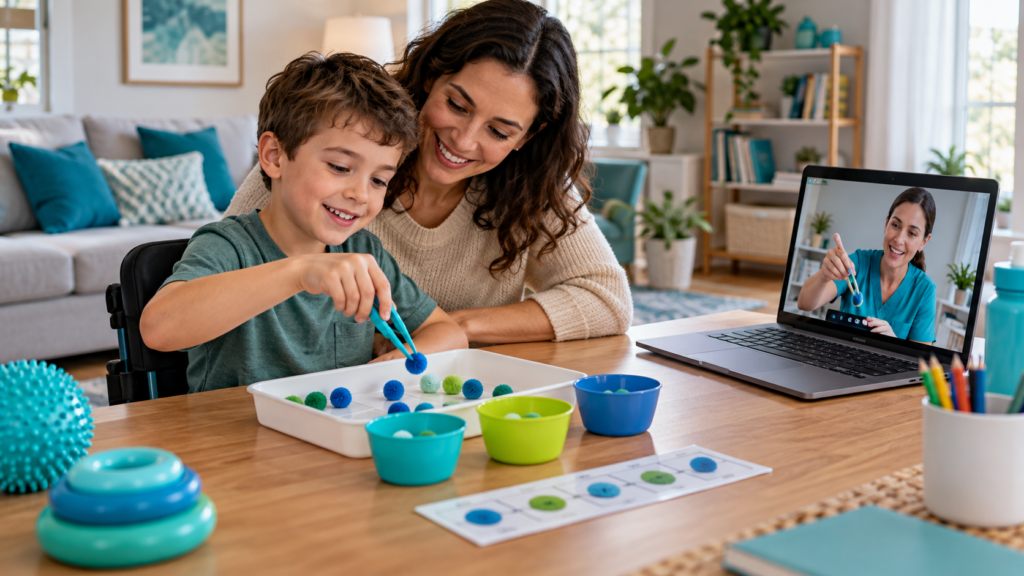
Families play an important role in rehabilitation, but helping someone recover or develop skills at home does not mean becoming their therapist. Useful support starts with shared goals, manageable routines, an accessible environment and an agreed plan with qualified professionals. This guide explains how caregivers can encourage participation while respecting the person’s autonomy and their own well-being.
Home rehabilitation is about everyday life
Rehabilitation aims to improve functioning and participation in meaningful activities. At home, progress may mean getting dressed with less assistance, preparing a snack, communicating a choice, walking safely to the garden, returning to a hobby or managing a daily routine. The most helpful family question is: What does this person want or need to do, and what makes it difficult today?
Rehabilitation is not always about restoring a lost ability. It may also involve adapting tasks, using assistive devices, changing an environment or developing new strategies. The person receiving care should participate in setting goals whenever possible.
1. Agree on goals with the person and their care team
Start with one or two specific, achievable activities rather than a long list of generic exercises. Ask the occupational therapist, physiotherapist, speech-language therapist or other clinician which activities are appropriate at home, which require supervision, how to assist and when to stop. A shared goal could be: “Complete the morning dressing routine using the agreed visual sequence, with less verbal prompting over the next few weeks.” The timeframe and method must be tailored to the individual.
A useful plan answers five questions: What activity? Why does it matter? What help is allowed? How will progress be observed? When will the plan be reviewed?
2. Make routines sustainable
Home practice is more likely to continue when it fits existing life. Link it to a regular activity, such as getting ready for school, setting the table, sorting laundry or preparing breakfast. Short opportunities embedded in daily routines may be more acceptable than an additional demanding session. The appropriate duration and frequency depend on the condition, fatigue, goals and clinician’s instructions; there is no universal home rehabilitation dose.
Consistency does not mean perfection. Some days require rest or adapting the task. Avoid rewarding excessive effort or treating missed practice as failure.
3. Provide the right amount of assistance
Too much help can reduce opportunities for independence; too little support can create frustration or danger. Clinicians may recommend graded assistance: preparing the materials, giving a visual cue, demonstrating one step, offering a verbal prompt or providing physical assistance when specifically indicated. Gradually reduce support only when the person can manage safely.
Ask before helping and allow sufficient processing time. Respect refusal, personal preferences and dignity. The objective is not to force task completion at any cost but to make meaningful participation more achievable.
4. Adapt the environment before adding technology
Home environments can either support or obstruct participation. Consider lighting, noise, clutter, the height and stability of furniture, reachability of objects, accessible communication supports and predictable organization. An occupational therapist can advise on modifications and assistive equipment; a physiotherapist may advise on safe mobility in specific situations.
Do not independently introduce unsafe balance exercises, transfer techniques, restrictive devices or unsupported physical assistance. Where falls, swallowing problems, medical instability or other significant risks are present, obtain individualized clinical advice.
5. Use digital tools selectively
Video instructions, visual schedules, reminders, accessible communication apps, therapist-selected games and telehealth follow-ups can make a plan easier to understand and monitor. Digital tools are optional supports, not proof that a rehabilitation programme is more effective. Choose a tool only when it helps a specific goal, is accessible to the person and does not add disproportionate costs or stress.
For example, a child working on school preparation may benefit from a simple picture sequence; a person recovering after stroke may use a checklist for kitchen tasks when appropriate; an adult with communication difficulties may need an individually selected augmentative and alternative communication (AAC) system.
AI-generated exercises or advice should not be used as individualized clinical instructions without review by a qualified professional. Virtual reality and motion tracking require attention to suitability, supervision, tolerability and limitations of recorded metrics.
6. Observe meaningful change, not just exercise counts
Progress can be discussed in everyday terms: Can the person complete more steps? Do they need fewer reminders? Is the activity less tiring? Can they participate with greater confidence? Are skills transferring from a game or exercise into actual daily life?
Agree on a small set of practical indicators with the therapist, such as assistance required, completion of a meaningful task, comfort or participation frequency. Recording too much information can burden the family and may distract from the person’s experience.
7. Communicate with the care team
Caregivers can share observations about fatigue, motivation, barriers, successes and difficulties that are not visible in clinic. Use the communication channel agreed with the care team, especially when sharing videos or health information. Ask how to manage setbacks and whom to contact if the person’s condition changes.
Sudden neurological symptoms, chest pain, severe breathing difficulties or other acute warning signs require urgent medical assessment rather than continued home exercises or a message through a rehabilitation app. Follow local emergency guidance.
8. Protect autonomy, privacy and caregiver well-being
The person receiving rehabilitation is not an exercise project. Their choices, consent, privacy and priorities matter. For children, provide age-appropriate choices and involve guardians according to applicable rules. For adults, avoid assuming that caregivers are authorized to make all decisions or access all health data.
Family members may also experience time pressure, physical strain and emotional fatigue. A realistic programme should clearly define what caregivers are willing and able to do. When the workload is excessive, discuss adaptations, respite or additional services with the care team. A home programme that causes sustained stress may need redesigning.
Three everyday examples
A child preparing for school
The family and occupational therapist identify that packing the schoolbag is difficult because the child loses track of the steps. A visual checklist and predictable storage locations support the routine. Rather than doing the task for the child, the caregiver uses the agreed prompts and notices whether assistance decreases. The plan is reviewed if frustration rises.
An adult recovering from stroke
The person wants to prepare a simple drink. The therapist first assesses mobility, reaching, cognition and safety. The family organizes the workspace and provides only the recommended level of assistance. Progress is evaluated through actual task performance, not solely arm repetitions or a game score.
An older adult maintaining community participation
An older adult wishes to visit a nearby friend. The care team considers walking ability, fatigue, transport and environmental barriers. The family helps plan the outing and shares feedback, while the person keeps control of the goal. A phone reminder might help; an immersive device is not inherently necessary.
These examples illustrate reasoning rather than provide individual medical prescriptions.
A practical seven-point family checklist
- Agree on a meaningful goal with the person.
- Confirm the activity and safety instructions with the clinician.
- Make the task accessible in the real home environment.
- Use the least assistance that remains safe and appropriate.
- Choose a sustainable practice opportunity within daily routines.
- Observe functional participation rather than chasing app scores.
- Review progress, burden and next steps together.
الأسئلة الشائعة
Should families supervise every rehabilitation exercise?
Not necessarily. Supervision depends on the person’s needs and the risk profile of the task. Follow the individualized plan and avoid unsupervised activities when supervision is prescribed.
Is more practice always better?
No. Excessive practice can increase fatigue, frustration or risk. Dosage must be individualized and adjusted with the clinical team.
What if the person refuses an activity?
Explore discomfort, preferences, task difficulty or timing without coercion. Discuss persistent barriers with the clinician, and adapt goals collaboratively.
Can digital games replace real-life activities?
They can supplement practice, but transfer to meaningful everyday participation should be evaluated directly.
What if the family cannot afford devices?
Technology should not be a prerequisite for care. Ask the team about low-cost, accessible or non-digital alternatives.
خاتمة
Families can strengthen rehabilitation by creating opportunities for meaningful activity, offering appropriate support and contributing their knowledge of daily life. Their role is collaborative, not a substitute for clinical expertise. The best home plan is safe, realistic, person-centred and sustainable for everyone involved.
For further context, read Digital Rehabilitation for Families and Caregivers, Technology in Occupational Therapy و The Future of Physiotherapy.
Further reading
- World Health Organization — Rehabilitation: rehabilitation as part of universal health coverage.
- World Health Organization — Recommendations on Digital Interventions for Health System Strengthening (2019): digital tools as components of care systems.
- World Health Organization — Assistive Technology: accessibility and supportive products.