

مقدمة
Stroke rehabilitation is a multidisciplinary process that aims to improve functioning, independence and participation after a cerebrovascular event. Technologies such as virtual reality (VR), serious games, movement sensors, telerehabilitation and artificial intelligence (AI) can extend the range of practice and feedback available to therapists. Their value depends on selecting the right patient, goal, intervention and measure—not simply introducing a new device.
Understanding rehabilitation needs after stroke
Stroke can affect muscle strength, coordination, balance, walking, sensation, communication, attention, memory, executive functions, mood, swallowing and everyday participation. Impairments vary widely in severity and evolve over time. A rehabilitation plan should be developed with the person and an interdisciplinary team, taking account of medical stability, fatigue, pain, cognition, home environment and preferred activities. Technology is one component of this individualized pathway.
What the scientific evidence supports
A 2025 Cochrane review of virtual reality after stroke included 190 studies involving 7,188 participants. It reported that VR may provide small benefits for upper-limb function and balance compared with alternative therapies and that adding VR to usual care probably improves arm function, while confidence in the evidence varied from moderate to very low. Effects on walking speed, quality of life and participation were less certain. A Cochrane review of telerehabilitation included 22 trials and 1,937 participants, finding that heterogeneous interventions and limited evidence prevented broad claims of superiority or equivalence. These reviews concern varied technologies, not proof of efficacy for any particular commercial platform.
Upper-limb rehabilitation: task practice and feedback
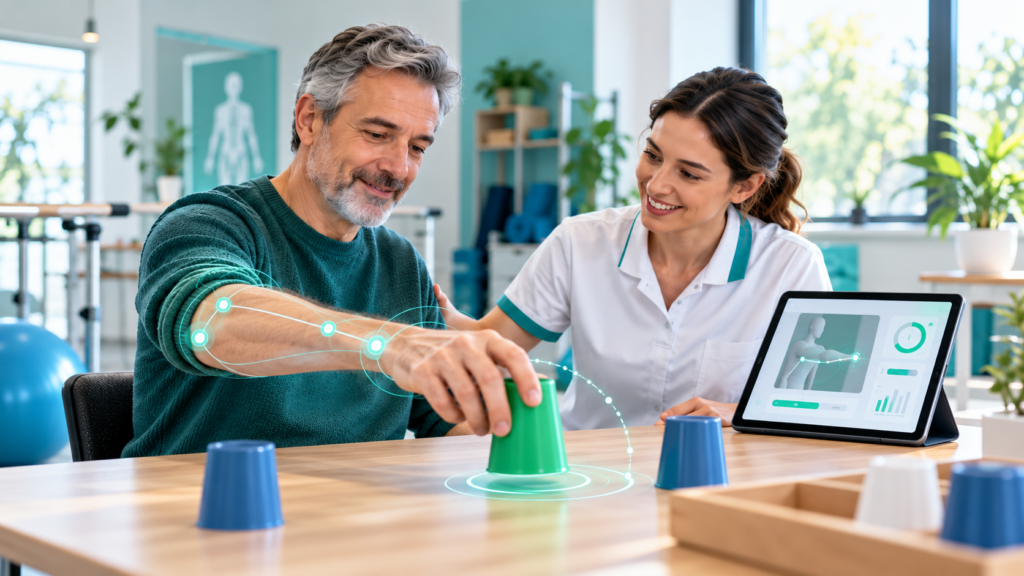
Reaching, grasping, manipulating objects and integrating the affected arm into daily activities may be rehabilitation targets. Depending on the person’s abilities and therapy plan, interactive tasks can provide structured repetition and immediate feedback. Game accuracy, speed and range estimates should be contextualized: compensation, fatigue and device tracking errors can lead to apparently better scores without better movement quality or occupational performance. Clinicians should connect practice to meaningful tasks such as preparing food or handling personal items.
Gait, balance and mobility
Digital exercises may support selected stepping, weight-shifting or postural activities and may record timing or performance trends. However, balance challenges can cause falls, and unsupervised VR may be unsuitable for some individuals. Mobility assessment must consider assistive devices, cognition, visual field differences, spatial neglect and environmental hazards. Hands-on examination and in-person supervision remain essential when required by clinical risk.
Cognitive rehabilitation and everyday executive functions
Some people experience difficulties with memory, attention, planning, sequencing or visuospatial processing after stroke. Interactive tasks may create opportunities to practise elements of these functions, but improvements in a digital exercise do not establish transfer to complex activities. Use individualized functional goals—following a meal-preparation sequence, managing a schedule or organizing a shopping task—and reassess performance in authentic contexts. Cognitive assessment tools require validation for their mode of delivery and intended interpretation.
Communication and interdisciplinary support
Speech-language therapists can address aphasia, communication strategies and appropriate augmentative and alternative communication. Occupational therapists, physiotherapists, neuropsychologists, rehabilitation physicians, nurses and others contribute expertise according to needs. Digital education, accessible communication tools and selected remote coaching may support teamwork, but technological access and patient preference must be respected. Avoid using automated text or speech outputs as a substitute for professional language assessment.
VR, AR and serious games: selecting the modality
Non-immersive screen-based activities, immersive VR and augmented or mixed-reality experiences have different demands. Consider cybersickness, vestibular symptoms, visual impairment, seizure-related precautions when relevant, hemineglect, hearing, device ergonomics and the need for assistance. The least complex suitable option may be preferable. For each activity, define the specific clinical goal and how a real-world outcome will be checked.
Remotion: therapist-controlled personalization
Remotion Classic provides therapist-centred interactive rehabilitation activities across supported devices. Remotion TheraVerse enables clinicians to configure virtual rooms, position interactive objects and apply visual, auditory and compatible vibration-based haptic cues. These capabilities may support adaptable practice scenarios, but do not automatically establish treatment efficacy or validated assessment performance for stroke. The therapist remains responsible for safety, task selection, appropriate progression and evaluating whether gains transfer to everyday activities.
AI, low-code tools and the augmented therapist
AI can help therapists draft accessible instructions, organize de-identified session summaries, prototype personalized activities and explore data trends. Clinicians increasingly benefit from AI literacy and low-code development skills to design tools around individual functional needs. But an AI-generated exercise or dashboard is not a clinically validated medical application. Models may produce incorrect recommendations, overlook compensatory movement or amplify bias; human review, software testing, privacy protections and regulatory assessment remain necessary. AI should not independently diagnose deterioration, change treatment intensity or determine discharge using unvalidated signals.
Measuring meaningful outcomes
Use a layered approach combining patient-defined goals, relevant standardized clinical measures, patient-reported experience and carefully interpreted digital task metrics. Examples of instruments used in stroke rehabilitation include the Fugl-Meyer Assessment, Action Research Arm Test, Berg Balance Scale and measures of activities of daily living, where appropriate and administered according to their instructions. Selection, scoring and interpretation require clinical training. Measure whether the person actually participates more effectively in dressing, cooking, walking or social roles rather than equating repetitions or game points with recovery.
Hybrid care and telerehabilitation
In-person evaluation can establish baseline status, manage risks and address hands-on needs, while selected video follow-ups or supervised home activities can extend practice. Evidence is intervention- and population-specific. A randomized study of 124 adults found comparable upper-limb motor outcomes between a specific six-week home telerehabilitation programme and dose-matched clinic therapy; this does not establish equivalence for all protocols. Set clear stopping rules, communication channels and criteria for reassessment in person. Randomized clinical trial, JAMA Neurology (2019).
Safety and clinical risk management
Before introducing digital therapy, screen for medical instability, falls, fatigue, pain, cognitive or visual difficulties and the home environment. Establish supervision requirements, emergency escalation and appropriate device hygiene. Unexpected weakness, facial drooping, speech changes or other sudden neurological symptoms warrant urgent emergency assessment—not another rehabilitation exercise. Protect patient autonomy and avoid coercive monitoring. A headset or motion-tracking application cannot replace clinical assessment.
Regulatory reminder: Europe, United States and Middle East
European Union
Personal and health-data processing must comply with the قانون حماية البيانات الشخصية. Software with a medical intended purpose may fall within the Medical Device Regulation (EU) 2017/745, with intended use and claims determining qualification and classification. The EU AI Act may impose additional obligations for qualifying AI systems; check the applicable phased dates and current legislation.
United States
Medical-purpose software may be subject to FDA oversight depending on functionality and exemptions. HIPAA applies to defined covered entities and business associates—not every consumer health app; the FTC and state rules can be relevant in other cases. Remote professional practice and reimbursement have jurisdiction-specific requirements.
Middle East
There is no single regional regime. In Saudi Arabia, consult SFDA Guidance on Digital Health Products (MDS-G027), including its discussion of VR, AI and Software as a Medical Device, and relevant data-protection rules. In the UAE, assess applicable medical-product rules and health information legislation, including Federal Law No. 2 of 2019. In Qatar, consider Personal Data Privacy Protection Law No. 13 of 2016 alongside local health-authority requirements. Cross-border practice, cloud hosting, health-data transfers and patient safety obligations require local review.
Medical claims, intended purposes and product functions—not marketing labels such as “game” or “AI”—are central to regulatory assessment. This overview is educational and not legal advice.
Three illustrative clinical pathways
Upper-limb function in daily life
An adult prioritizes preparing breakfast. After professional assessment, selected interactive reaching tasks supplement individualized practice. The team evaluates real kitchen performance, assistance needs and safety, not only digital scores.
Attention and sequencing
A person has difficulty organizing a multistep household activity. Therapists use appropriate cognitive strategies and a configurable digital exercise as supporting practice, then assess everyday task completion.
Hybrid mobility follow-up
A clinician assesses balance and mobility in person, offers appropriate home guidance and reviews progress remotely when safe. Any new instability prompts a physical reassessment.
These scenarios illustrate clinical reasoning, not individualized treatment prescriptions.
Questions frequently asked
Does VR work for everyone after stroke?
No. Potential benefit, tolerance and safety depend on the intervention, individual and goal. Evidence is not uniform.
Can game scores replace clinical assessments?
No. Scores can support observation but require validation before they are interpreted as clinical outcomes.
Can AI automatically prescribe post-stroke therapy?
Unvalidated AI should not independently make therapeutic decisions. Professional assessment and oversight are essential.
Is home-based telerehabilitation equivalent to clinic care?
Some specific programmes have shown comparable outcomes in selected trials, but equivalence cannot be generalized.
Do patients need a VR headset?
No. Ordinary screens, home activities, appropriate assistive technology and in-person care may be more suitable.
Conclusion and further reading
Stroke rehabilitation is fundamentally about regaining meaningful function and participation. VR, serious games, motion sensing, AI and remote care can expand the therapist’s repertoire when clinically justified, accessible and safely governed. Strong services combine evidence, personalized goals, real-world assessment and professional accountability.
Related reading: Measuring Outcomes in Hybrid Rehabilitation; Remote Assessment; Privacy and Clinical Risk Management.
- Laver KE et al. Virtual reality for stroke rehabilitation, Cochrane, 2025.
- Laver KE et al. Telerehabilitation services for stroke, Cochrane, 2020.
- NICE evidence review: telerehabilitation for adults after stroke, 2023.
- Home-based telerehabilitation versus in-clinic therapy after stroke, JAMA Neurology, 2019.