

مقدمة
Telerehabilitation is no longer just an emergency substitute for face-to-face appointments. It is one possible method of delivering assessment, therapeutic guidance, education, monitoring and follow-up when distance, access or continuity of care matter. Yet its value cannot be judged simply by whether a video call works. Effective telerehabilitation must improve access while protecting clinical quality, safety, inclusion, privacy and meaningful participation.
Definition and scope
Telerehabilitation uses information and communication technologies to support rehabilitation services when the professional and the person receiving care are in different locations. It can involve synchronous video sessions, asynchronous instructions and feedback, remote observation, secure communication and selected digital therapeutic activities. It is not synonymous with a generic exercise app or wholly autonomous treatment.
According to the World Health Organization’s framing, rehabilitation focuses on optimizing functioning in interaction with a person’s environment. Remote delivery therefore should be evaluated against real activities and participation, not merely screen time or session counts.
Four delivery models
Synchronous care
A clinician and patient interact live, through video or another suitable channel, to discuss goals, coach an activity or review selected functions.
Asynchronous care
Therapists prescribe appropriate activities or educational resources, and feedback is reviewed later. Instructions, communication and escalation criteria must be clear.
المراقبة عن بعد
Selected questionnaires, logs or sensor measurements support follow-up. Data quality, consent and clinical interpretation are essential; continuous monitoring is not automatically necessary.
Hybrid or blended care
Physical assessment and in-person sessions are combined with remote interventions when appropriate. Hybrid models may preserve hands-on assessment while extending support into real-life contexts.
Scientific evidence: promising, but not universal
Research findings vary by diagnosis, type of intervention, comparator and outcome. The Cochrane review by Laver and colleagues (2020) examined 22 randomized trials involving 1,937 stroke survivors. It found no clear differences for several outcomes when telerehabilitation was compared with face-to-face care or usual care, but evidence was mostly low to moderate certainty, intervention types differed substantially and firm conclusions about superiority, cost-effectiveness or safety were not possible. Similar measured outcomes in some trials should not be framed as proof that all remote care is equivalent to in-person rehabilitation.
WHO’s 2024 toolkit for accessible telehealth highlights that digital services must be designed for people with disabilities, including those using assistive technologies. A 2025 WHO account of the OpenTeleRehab platform provides a practical example of improving compatibility with screen readers, navigability and text scaling. These are implementation considerations, not proof of clinical effectiveness for every telerehabilitation service.
The responsible interpretation is that telerehabilitation can be clinically useful for selected patients and tasks, while outcome evidence, adverse-event reporting and economic evaluation need continued attention. Service design should remain condition-specific and person-centred.
Clinical applications across disciplines
Occupational therapy
Therapists may observe self-care, household tasks, school routines, executive-function strategies, home accessibility and assistive-technology use. Remote observation can reveal environmental barriers that are less visible in a clinic.
Physiotherapy
Selected exercise education, movement coaching, home activity programmes and mobility follow-up may be feasible after appropriate risk assessment. Complex transfers, unstable balance or hands-on examinations may require in-person care.
Speech-language therapy
Telepractice can support selected language activities, caregiver coaching and augmentative and alternative communication (AAC) implementation. Hearing, audio quality, communication access and privacy influence suitability.
Neurorehabilitation and cognitive care
Structured cognitive exercises, everyday task planning and caregiver education may complement neurological rehabilitation, but standardized tests cannot simply be moved online without checking validity and administration requirements.
Pediatrics and family-centred rehabilitation
Digital sessions should accommodate developmental level, sensory comfort, attention, consent, caregiver workload and school or family context. Children may benefit from brief functional activities rather than lengthy screen-based tasks.
Psychology, psychomotor therapy and multidisciplinary rehabilitation
Selected interventions can be delivered remotely under applicable professional standards, with attention to safeguarding, therapeutic alliance, emergency plans and appropriate access.
Patient selection and contraindications
Suitability depends on the person’s goals, cognition, communication, movement safety, medical stability, digital accessibility, home environment and available support. Remote assessment is not a replacement for physical examination whenever hands-on findings are essential. Activities involving fall risks, complex transfers, acute neurological changes, severe instability or other clinical red flags may require an in-person or emergency response.
Define a plan for what happens if the connection fails, symptoms change or the person cannot safely perform the activity. The technology should adapt to the clinical pathway rather than determine it.
Building an effective clinical pathway
- Assess suitability: clarify referral, goals, risk, accessibility and remote-versus-in-person needs.
- Establish a baseline: assess meaningful function using suitable validated methods.
- Select a delivery model: synchronous, asynchronous, monitoring or hybrid.
- Prepare participants: explain consent, privacy, devices, instructions and caregiver roles.
- Deliver and adapt: provide graded, clinically supervised activities with clear stopping criteria.
- Review outcomes: examine real-world participation, patient feedback and treatment burden.
- Escalate or transition: move to in-person assessment when remote delivery is insufficient.
Technology architecture and accessibility
A practical platform may combine video communication, structured exercises, therapist configuration, notes, appointment workflows, outcome reports and selected sensor integration. However, the architecture should protect data, work across appropriate devices and offer accessible alternatives. Design should account for captions, keyboard navigation, assistive technologies, readable text, language, hearing and vision needs, and limited internet access.
Offline educational resources or audio-only follow-up may be preferable to a complex app in some contexts. WHO and ITU accessibility work underscores the need to include people with disabilities when designing telehealth services.
VR, motion tracking and interactive rehabilitation
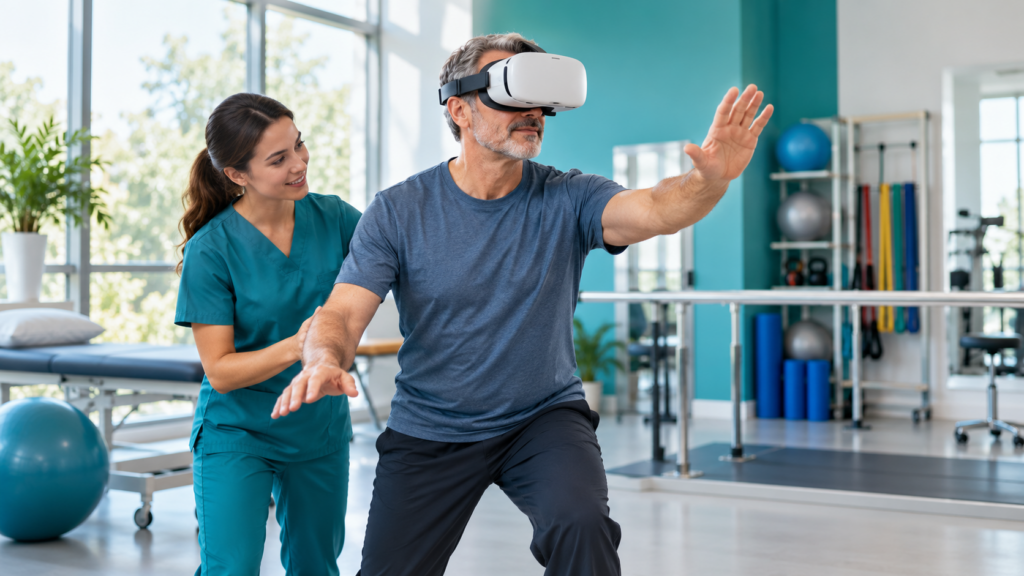
Serious games, camera-based tracking and immersive experiences can make remote practice more engaging and provide selected performance metrics. Yet game scores do not automatically reflect clinical recovery, and camera-estimated movement may be affected by occlusion, position or device differences. A therapist must review functional transfer and safety.
Remotion explores therapist-centred interactive rehabilitation across screens and immersive devices. Remotion Classic offers a library of activities; Remotion TheraVerse supports configurable virtual environments that clinicians can populate with interactive objects and visual, auditory or compatible vibration-based haptic cues. Use in remote pathways requires case-specific assessment of connectivity, hardware, supervision and actual available features, rather than an assumption that every immersive function is appropriate for home use.
AI and the augmented rehabilitation professional
AI can support documentation drafts, accessible instructions, translation for review, activity adaptation and rapid prototyping of simple interactive tools. Therapists increasingly need AI literacy to evaluate such tools and specify solutions adapted to their patients. AI-assisted or low-code development can shorten prototyping, but a functioning prototype is not automatically a clinically valid or legally marketable medical product.
Clinical reasoning, informed consent, data minimization, human review, cybersecurity and appropriate validation remain mandatory considerations. Do not upload identifiable patient records to general-purpose AI services without an appropriate legal and organizational framework.
Measuring outcomes and service quality
Use a combination of meaningful functional goals, clinical measures, patient-reported outcomes, adherence and service-access indicators. Relevant service metrics can include missed appointments, travel avoided where justified, technical failures, accessibility problems and treatment workload. A reduction in travel burden does not prove improved health outcomes, and increased repetitions do not prove better everyday participation.
Audit adverse events and failures, document reasons for switching modality and assess patient and clinician satisfaction without relying on satisfaction alone as evidence of effectiveness.
International regulatory reminder
European Union
The قانون حماية البيانات الشخصية governs personal data, including additional safeguards for health information. Medical-purpose software may qualify under the EU Medical Device Regulation 2017/745; classification depends on intended purpose and functionality. The EU AI Act can introduce further requirements for qualifying AI systems, with staged application and legislative developments that must be checked against current official guidance. Professional licensing and cross-border telehealth rules also require assessment.
United States
HHS HIPAA telehealth guidance applies where covered entities and their business associates handle protected health information; not all consumer tools automatically fall under HIPAA. FDA device-software policies may apply to medical-purpose functions, while clinician licensure, consent, reimbursement and telehealth delivery rules vary by state and programme.
Middle East
There is no single regional framework. In Saudi Arabia, review SFDA digital-health product guidance and applicable personal-data rules. In the United Arab Emirates, examine health-data requirements, including Federal Law No. 2 of 2019 on ICT in Health Fields, applicable healthcare authority rules and medical-product requirements. In Qatar, consider Personal Data Privacy Protection Law No. 13 of 2016 and relevant Ministry of Public Health requirements. Cloud hosting, cross-border patient data and whether clinicians may deliver cross-border care require local assessment.
Regulatory distinction: a video consultation service, a generic exercise library, software that analyzes clinical deterioration and an AI system recommending treatment may be regulated differently. Clearly document intended use and seek jurisdiction-specific advice. This section is educational, not legal advice.
Three clinical illustrations
Home-based occupational therapy after stroke
An initial in-person assessment establishes safe parameters. Selected daily-life tasks are coached through video, while the therapist reviews actual independence and determines when another physical assessment is needed.
Pediatric communication support
A speech-language therapist works with a caregiver on AAC modelling during play. Sessions are brief and accessible, and the child’s preferences guide participation. Technology supports the interaction rather than replacing it.
Older adult with mobility concerns
A physiotherapist uses a hybrid pathway: in-person examination where needed, remote education and scheduled check-ins. Any increased fall risk prompts reassessment rather than continuing unsupervised progression.
These scenarios illustrate service design and are not individualized prescriptions.
الأسئلة الشائعة
Is telerehabilitation as effective as in-person therapy?
Evidence depends on the condition, treatment and outcome. Some studies found similar results for selected measures, but broad equivalence cannot be assumed.
Is video consultation the same as telerehabilitation?
No. It is one channel within a larger process that includes assessment, planning, therapeutic work, follow-up and outcomes.
Can VR and AI replace a rehabilitation professional?
No. They may support selected activities, but individualized clinical decisions and safety oversight require qualified professionals.
Do all patients need expensive hardware?
No. Many services can use accessible common devices, telephone follow-up or non-digital materials.
Can patients receive remote rehabilitation across borders?
Potentially, but professional authorization, privacy, insurance and telehealth rules vary between jurisdictions and should be checked beforehand.
خاتمة
Telerehabilitation can extend the reach of rehabilitation and connect treatment more closely to everyday settings. Its success depends on sound clinical selection, accessible technology, professional accountability and meaningful functional outcomes. The most sustainable future is likely to combine in-person expertise with remote tools in ways that are individually justified rather than technologically predetermined.
Related reading: Telerehabilitation for Families, Digital Tools in Occupational Therapy, ، و The Future of Physiotherapy.
References
- Laver KE et al. Telerehabilitation services for stroke. Cochrane Database of Systematic Reviews (2020).
- WHO and ITU. Implementation toolkit for accessible telehealth services (2024).
- WHO. OpenTeleRehab: a success story of inclusive telerehabilitation (2025).
- WHO. Support tool to strengthen telemedicine (2024).
- US HHS. HIPAA Rules for Telehealth Technology.