

مقدمة
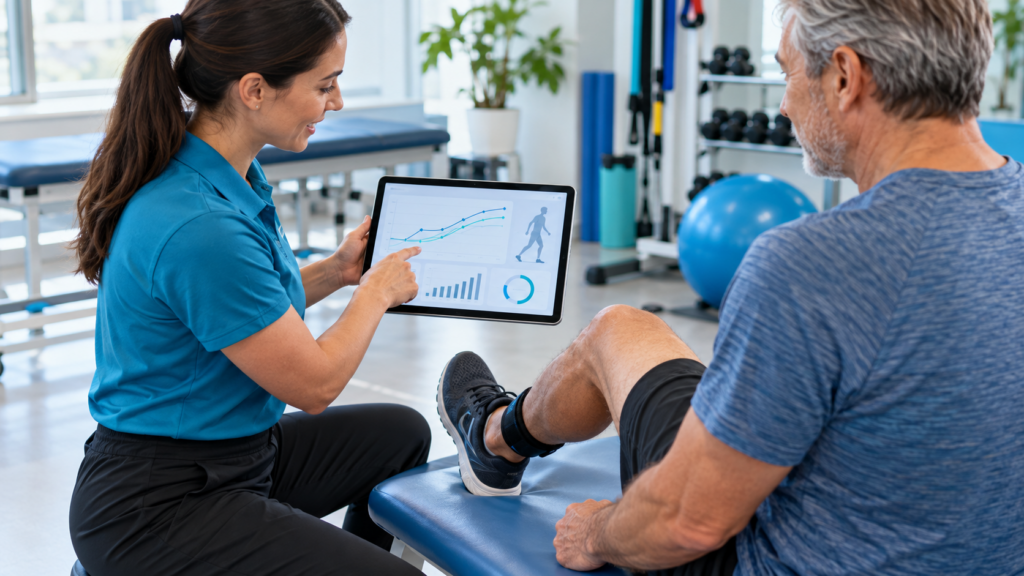
Digital rehabilitation can record repetitions, movement trajectories, response times, errors, pauses and exercise attendance. These data can be useful, but collecting more does not necessarily mean understanding more. Families and professionals need to know whether a person is becoming more independent, comfortable and able to participate in meaningful activities. Tracking should support care rather than turn daily life into continuous surveillance. This guide explains how to choose practical measures, interpret technology-generated scores, use AI responsibly and respect privacy across different regulatory settings.
Begin with a meaningful functional goal
Before selecting a measurement, define the person’s goal: preparing breakfast, using a schoolbag independently, communicating a need, walking to a friend’s house or participating in play. Describe current performance, the assistance required and the environmental context. An outcome is meaningful when it reflects something the person values. Game points or device usage time may show engagement, but they do not directly demonstrate participation in real life.
What kinds of progress can be measured?
- Activity performance: whether the task is completed, time needed, quality, errors and assistance.
- Participation: whether the person engages in chosen roles and real environments.
- Patient- or family-reported outcomes: perceived difficulty, confidence, fatigue, satisfaction and impact.
- Clinical measures: standardized scales or assessments selected and interpreted by qualified professionals.
- Digital process measures: repetitions, reaction time, head or hand movement, pauses, accuracy or session frequency.
These categories complement one another. An improvement in an app’s reaction-time score should not be described as a clinical gain unless the relationship has been appropriately established.
Set a baseline and a small measurement plan
A practical approach is to choose one or two meaningful outcomes plus a small number of supporting indicators. For example, a person after stroke may want to prepare a drink: the team records independence, assistance and safety during the real task, while using relevant game scores only to contextualize practice. Agree in advance on what will be recorded, who will review it, when review happens and what action a change could justify.
Measure at clinically useful intervals. Daily scores may be unnecessary for slowly evolving outcomes. A person should not feel obliged to produce data to prove they are trying.
Avoid five common monitoring traps
- Measuring what the software can count instead of what matters. Easy-to-capture data are not always clinically important.
- Confusing adherence with improvement. More sessions do not prove greater independence.
- Overinterpreting small variations. Scores change with fatigue, mood, device placement, learning and environmental conditions.
- Ignoring burden. Tracking can create anxiety, shame, extra caregiver work or loss of privacy.
- Collecting data without a decision. If a measure will not improve care or inform an agreed review, question why it is being recorded.
How therapists can interpret digital rehabilitation metrics
Camera-based tracking, inertial sensors, VR controllers and game logs can provide structured observations. However, occlusion, calibration, motion compensation, sensor drift, hardware differences and software updates affect accuracy. Not all estimates of joint range, symmetry, movement quality or attention have been validated for clinical use.
Therapists should ask what each metric actually measures, which conditions produce errors, and whether changes transfer to meaningful tasks. Compare like with like, document relevant device changes and avoid ranking patients against one another without appropriate evidence.
AI can help summarize, not replace clinical reasoning
AI may help organize session notes, draft accessible summaries, display trends or propose questions to discuss with the care team. Clinicians increasingly need AI literacy to assess these systems and, when appropriate, prototype personalized tools. With AI-assisted low-code workflows, a therapist might develop a simple task tracker, an accessible progress chart or a customized educational activity. Such prototypes require testing before clinical deployment.
AI-generated interpretations can be wrong, omit context, produce plausible but unsupported recommendations or expose sensitive data. The therapist should verify inputs, outputs and clinical relevance. No consumer chatbot should autonomously prescribe exercise progression, diagnose regression or trigger medical decisions solely from unvalidated game data. Use de-identified or fictional information when prototyping unless approved systems and data safeguards are in place.
Involving the person and family in decisions
Tracking should be collaborative. Explain the purpose of each indicator, offer accessible ways to give feedback and respect the person’s preferences. Children should be involved according to their age and understanding; parents or guardians need clear information about recordings and access. Adults receiving care should not automatically lose control over their data because a caregiver helps with the device.
Offer options to pause tracking or use paper-based observations when appropriate. Celebrate meaningful changes without turning every activity into a performance assessment.
Privacy-by-design: collect less, protect better
Prefer data minimization: record what is necessary for an explicit purpose and retain it only as long as justified. Limit access by role, use secure authentication and appropriate encryption, establish retention and deletion rules, and control exports. Video, voice and movement traces can contain identifying information even without a visible name. Distinguish local processing from cloud transmission, and ask suppliers about subcontractors, hosting location, incident response and security updates.
A family should know whether a game only gives immediate feedback or stores identifiable longitudinal health data. These are not the same privacy proposition.
Regulatory reminder: Europe, the United States and the Middle East
European Union
The قانون حماية البيانات الشخصية applies to personal-data processing, with additional safeguards for health data and specific rules around legal basis, transparency, security and individual rights. Software intended for medical purposes can fall under the Medical Device Regulation (EU) 2017/745; its intended purpose and functions determine qualification and classification. The EU AI Act may add requirements depending on AI functionality and risk, with a phased and evolving implementation timetable. An AI-generated progress chart is not automatically a medical device, but software claiming to detect deterioration or direct therapy may require a different assessment.
United States
The FDA assesses medical-device software functions according to intended use and applicable exclusions; its 2026 clinical decision-support guidance clarifies relevant boundaries. HIPAA applies to covered entities and business associates in defined circumstances, not to every wellness app. Some non-HIPAA health services may be subject to FTC privacy and Health Breach Notification Rule obligations.
Middle East: country-by-country assessment
No single framework covers all Middle Eastern markets. In Saudi Arabia, the SFDA publishes Guidance on Digital Health Products (MDS-G027) and medical-device authorization requirements may apply according to claims and function. In the United Arab Emirates, assess applicable medical-product rules, health authority requirements and health-data legislation, including Federal Law No. 2 of 2019 concerning ICT in health fields. In Qatar, assess the Personal Data Privacy Protection Law No. 13 of 2016 and relevant health-sector authorizations. Cross-border transfers, cloud hosting and children’s data require particular attention.
Practical boundary: a family checklist, a wellness dashboard, a clinician-facing progress analysis and a device making diagnostic or treatment claims may face very different obligations. Before deployment, define intended use, verify clinical evidence and cybersecurity, document responsibilities and seek qualified legal or regulatory advice for each target market. This overview is not legal advice.
Three family-centred scenarios
A child working on morning independence
The child and family choose school preparation as the outcome. Once weekly, they note how many steps can be completed with the agreed assistance. A game used in therapy may provide supporting information, but it does not replace observing the real routine.
An adult recovering after stroke
The goal is preparing a simple meal safely. The clinician evaluates the actual task, while selected movement metrics illustrate practice. Family members report fatigue or environmental obstacles only as agreed, without continuous camera monitoring.
An older adult maintaining social participation
The goal is visiting friends comfortably. Rather than accumulating step counts alone, the team reviews participation, confidence, support required and whether the plan is sustainable.
These are illustrative examples, not individual clinical prescriptions.
A ten-question checklist before turning tracking on
- What meaningful goal will this information help evaluate?
- Who requested tracking and does the person understand it?
- Can we use fewer or simpler measures?
- How accurate and clinically relevant are the metrics?
- Who can access, export or change the data?
- Is information stored locally or transmitted to other services?
- How long will the information be retained?
- Does a child or caregiver need additional safeguards?
- What will trigger a professional review rather than an automated decision?
- Can the person withdraw, pause or use a non-digital alternative where appropriate?
الأسئلة الشائعة
Should families log progress every day?
Not by default. Choose a schedule justified by the goal and agreed with the professional. Excessive logging may add burden without improving care.
Are game scores clinical measurements?
Not automatically. They can support observation, but their validity for a particular health outcome must be established.
Can AI detect rehabilitation deterioration?
Do not rely on unvalidated AI systems for clinical deterioration alerts or treatment changes. Qualified professionals must evaluate the intended use, evidence and risk.
Can a caregiver monitor someone without consent?
Consent and legal authority depend on the individual’s circumstances and local law. In general, respect autonomy, explain monitoring and seek appropriate legal or clinical guidance.
Does GDPR or HIPAA apply to every rehabilitation app?
No. Coverage depends on jurisdiction, entities, processing and use. Other privacy or medical-device rules may still apply.
خاتمة
Rehabilitation progress should be measured in terms of what the person can do, choose and enjoy—not the volume of data collected about them. Digital tracking and AI can help professionals organize information and develop better-fitting tools, but effective care remains person-centred, clinically supervised and respectful of privacy. Collect only what helps answer a meaningful question, then use it to support decisions together with the person and family.
Related reading: Choosing Digital Rehabilitation Tools for Your Family, Digital Rehabilitation for Families and Caregivers و المعالج المعزز.
References and further reading
- منظمة الصحة العالمية. International Classification of Functioning, Disability and Health (ICF).
- European Union. GDPR (Regulation 2016/679) و MDR (Regulation 2017/745).
- European Commission. Regulatory framework for AI.
- US FDA. Clinical Decision Support Software: 2026 guidance.
- US FTC. Health Breach Notification Rule.
- Saudi SFDA. Guidance on Digital Health Products.