

Introduction
Hybrid rehabilitation combines in-person clinical care with selected remote activities, digital follow-up and home-based practice. It is not simply alternating video calls and appointments. A well-designed pathway assigns each task to the mode best suited to its clinical purpose, risk and accessibility requirements. The objective is continuity and meaningful functional improvement, not maximum screen time or minimum clinic visits.
What is a hybrid rehabilitation pathway?
A hybrid pathway is an organized sequence of assessment, treatment, education, practice and reassessment delivered through appropriate combinations of face-to-face and distance-based services. It may involve occupational therapy, physiotherapy, speech-language therapy, psychology, psychomotor therapy, rehabilitation medicine and family education. Technology is chosen to support an agreed rehabilitation goal, while professional responsibility remains clear.
A telephone consultation, secure video appointment, therapist-selected interactive game or printed home plan can each have a place. Hybrid care does not automatically mean advanced equipment or artificial intelligence.
Evidence and its limitations
Research into telerehabilitation suggests potential for selected conditions and outcomes. For example, the Cochrane review of telerehabilitation after stroke reported uncertain differences for several outcomes when compared with face-to-face rehabilitation or usual care; heterogeneity and the certainty of evidence limit generalization. Findings do not demonstrate that every hybrid pathway is equivalent or superior to in-person care. Studies of engagement, feasibility and acceptability also do not establish long-term functional effectiveness by themselves.
Local evaluation should examine safety, access, clinical outcomes, patient experience and costs rather than assume that a digitally enabled pathway is inherently better.
Step 1 — Define the person-centred goal
Start with participation. What is the person trying to achieve—preparing breakfast, returning to work, using a communication device, dressing for school, walking outdoors or engaging in social life? Document the baseline, environment, priorities, barriers and the level of assistance currently required. A specific functional goal provides a basis for deciding which elements require physical presence and which may safely occur at home.
Step 2 — Triage and assess clinical suitability
Identify clinical stability, fall risk, pain, balance, fatigue, cognition, communication, sensory needs, home environment, device access and family capacity. Determine which assessments require hands-on examination or equipment and which can be conducted remotely with acceptable reliability. Define red flags and an escalation route before assigning unsupervised home activity. Remote monitoring must not be used to manage acute medical symptoms when urgent physical assessment is indicated.
Step 3 — Allocate each activity to the right delivery mode
- In person: examinations requiring hands-on assessment, complex transfers, equipment fitting, activities with substantial safety risk or direct specialist intervention.
- Live remote: education, task demonstration, supported goal review and appropriate functional coaching.
- Asynchronous: therapist-approved instructions, routine-based activities and non-urgent feedback with clear parameters.
- Hybrid review: planned reassessment combining clinical measures, patient-reported outcomes and real-world performance.
The mix should change over time as needs, safety and goals evolve. It is a clinical decision, not a fixed percentage of in-person versus online visits.
Step 4 — Build a shared care plan
Record who does what: treating clinician, additional disciplines, patient, caregivers and technical support. Include the intended activity, frequency or dose specified by a professional, supervision, stopping rules, follow-up channel and review date. Explain the plan in accessible language and obtain appropriate consent. A caregiver may help prepare the environment or offer cues but should not be expected to deliver unsupervised clinical treatment.
Step 5 — Choose accessible, reliable technology
Select devices and software according to the user’s vision, hearing, motor abilities, cognitive needs, language, connectivity and budget. Consider keyboard accessibility, subtitles, audio-only alternatives, low-bandwidth options, data export and interoperability where appropriate. An inexpensive visual schedule may be more sustainable than a complex app. Before clinical use, test the actual home setup, including camera position, lighting, sound and support needs.
Step 6 — Integrate interactive rehabilitation, VR and AI responsibly
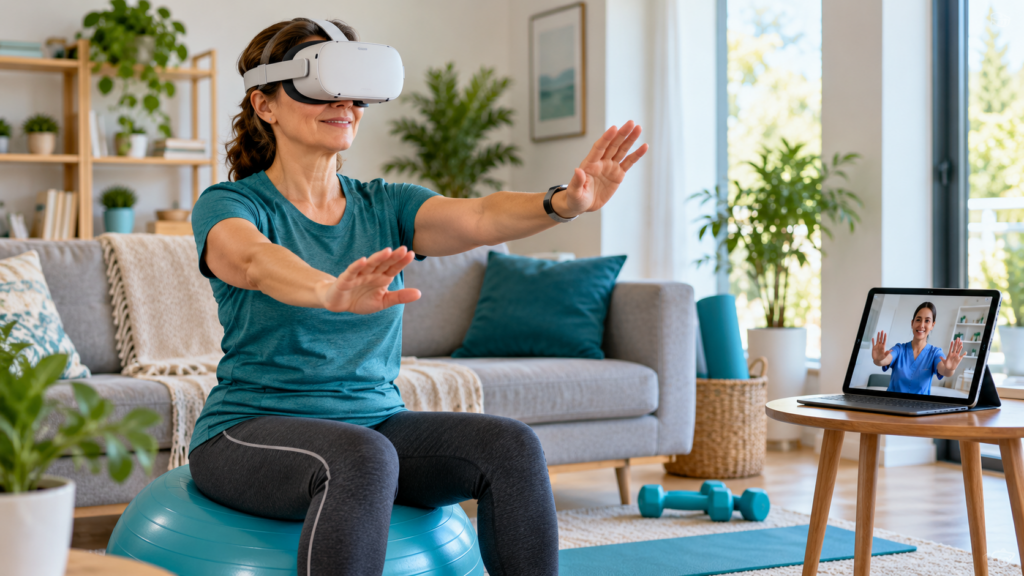
Therapist-directed interactive activities may help structure selected practice, and movement sensors can provide contextual data such as repetitions, timing or task accuracy. These indicators should not be equated automatically with clinical recovery. Virtual environments may allow tasks to be personalized, while immersive hardware adds considerations around balance, device age guidance, cybersickness, sensory load and supervision.
Remotion Classic offers interactive rehabilitation activities across supported devices. Remotion TheraVerse explores therapist-configurable virtual spaces: a clinician can position interactive objects within a virtual room and incorporate visual, auditory and compatible vibration-based haptic cues. These features can support scenario design but do not, alone, prove effectiveness for a specific diagnosis or guarantee suitability for unsupervised remote use.
Artificial intelligence may help clinicians draft accessible instructions, summarize non-sensitive information, develop learning resources or prototype simple personalized tools. Therapists increasingly need AI literacy to specify and assess solutions responsive to actual functional needs. A working AI-generated prototype is not the same as a clinically validated device: professional review, usability testing, risk analysis, data protection and applicable regulatory checks remain necessary.
Step 7 — Measure outcomes without over-monitoring
Combine outcomes that matter in daily life with appropriate standardized assessments and selected process metrics. A child may complete more dressing steps with fewer prompts; an adult after stroke may prepare a snack with less assistance; an older person may resume a community activity. Track whether improvements transfer beyond a game or session. Use the smallest useful dataset, explain what is being recorded and avoid making patients or families feel constantly observed.
Step 8 — Define governance and quality assurance
A hybrid programme needs a responsible clinician, documented eligibility criteria, a technical-support process, incident reporting, cybersecurity procedures, accessible patient information and escalation protocols. Agree on what happens when a video session fails, a wearable measurement appears implausible or a patient cannot complete an activity. Audit dropout, adverse events, inequities in access, patient experience and meaningful functional outcomes. Governance matters as much as software functionality.
Example pathway: stroke rehabilitation
Following an in-person assessment of movement, cognition and task safety, an interdisciplinary team identifies the person’s goal of preparing a simple breakfast. A therapist provides supervised practice and home-environment recommendations; selected tasks may be reviewed through a secure video session. A digital activity may supplement reaching or sequencing practice. Progress is checked through actual kitchen performance and appropriate clinical measures, with face-to-face reassessment if risks change. This example illustrates pathway design rather than prescribing a protocol.
Example pathway: pediatric developmental rehabilitation
A child and family prioritize school preparation. The occupational therapist observes the routine and agrees on environmental modifications and cues. An illustrated checklist or accessible game is used briefly between sessions; family workload and the child’s assent guide implementation. Live follow-up helps refine the plan, while in-person reassessment addresses motor or sensory concerns that cannot be adequately evaluated remotely. Goals remain participation and autonomy rather than exercise volume.
Example pathway: aging and community participation
An older adult wants to continue visiting friends. In-person assessment addresses mobility safety and assistive-device needs. Remote follow-up may support confidence, review environmental barriers and adjust a realistic activity plan. A phone call may serve better than a video platform when digital access is limited. Reassessment is triggered by new symptoms, increased fall risk or reduced participation.
Regulatory reminder: Europe, the United States and the Middle East
European Union
The GDPR governs personal-data processing, with specific protections for health information. Software with an intended medical purpose may qualify under the Medical Device Regulation (EU) 2017/745. The AI Act can create additional duties for certain AI systems; application dates and transitional rules must be checked against current official guidance. Professional licensing and cross-border care obligations may apply separately.
United States
FDA device-software rules depend on intended purpose and function. HIPAA applies to covered entities and business associates in defined circumstances, while some consumer health apps are subject to FTC requirements. Telehealth licensure, consent and reimbursement may vary by state and payer.
Middle East
Requirements are jurisdiction-specific. In Saudi Arabia, review SFDA digital-health guidance alongside applicable data protection rules. In the UAE, relevant medical-device pathways and the health-sector information framework, including Federal Law No. 2 of 2019, should be assessed. In Qatar, consider Personal Data Privacy Protection Law No. 13 of 2016 and applicable health-authority requirements. Cloud hosting, cross-border transfers and professional authorization need local review.
Practical distinction: a video consultation platform, a general exercise library, AI that recommends treatment and medical-purpose software can face different requirements. Document intended use and seek specialist advice before deployment. This overview is informational, not legal advice.
Frequently asked questions
What proportion of rehabilitation should be remote?
There is no universal percentage. The mix should reflect functional goals, safety, available evidence, professional judgment and patient choice.
Can AI determine when to discharge a patient?
AI may provide supporting information, but discharge decisions require qualified clinical assessment and an appropriate governance framework.
Do hybrid programmes require VR headsets?
No. A secure telephone or video service, printed resources and appropriate home activities may be sufficient.
How should families support home sessions?
Through roles agreed with the care team, such as preparing materials, offering cues or reporting concerns—not by independently altering treatment dosage or providing unsafe assistance.
How do teams know hybrid care is working?
Evaluate participation, functional outcomes, safety, accessibility, workload and satisfaction, rather than digital engagement alone.
Conclusion
An effective hybrid pathway is a clinical design rather than a technology package. It uses in-person care when physical assessment and direct intervention are needed, remote support when it improves access or relevance, and appropriate digital tools when they serve meaningful goals. Clinician-led personalization, shared decisions, outcome evaluation and regulatory awareness help ensure that hybrid rehabilitation remains safe, inclusive and responsive to real life.
Continue reading: Telerehabilitation: Definition, Evidence and Clinical Applications, Telerehabilitation for Families and Tracking Rehabilitation Progress Without Over-Monitoring.
References and further reading
- Laver KE et al. Telerehabilitation services for stroke. Cochrane review, 2020.
- WHO and ITU. Implementation toolkit for accessible telehealth services (2024).
- World Health Organization. International Classification of Functioning, Disability and Health.
- European Union. GDPR; MDR.