

Introduction
Remote assessment can help clinicians understand how people function in their own homes, schools and communities. But a video call, wearable sensor or AI-generated score does not automatically reproduce the validity of an in-person examination. The essential questions are which functional construct is being assessed, whether the remote method has acceptable measurement properties for the intended population, and whether it can be performed safely. Remote assessment should extend clinical access and observation—not weaken clinical reasoning.
What remote rehabilitation assessment includes
Teleassessment may involve a live video interview, observation of activities of daily living, patient-reported outcome measures, structured motor tasks, speech or communication assessment, photographs or recordings shared through approved channels, and selected wearable or camera-based measurements. Asynchronous assessments require explicit instructions and a defined clinical review process. The difference between screening, monitoring, formal diagnosis and standardized assessment must remain clear.
The evidence: promising but measure-specific
A 2025 systematic review of video-based physical fitness assessment analyzed 35 studies and 48 tests. Certain tasks, including the 30-second sit-to-stand in studied populations, demonstrated useful remote measurement properties, but evidence was uneven across domains and scarce for children. A 2025 COSMIN systematic review of motor teleassessment in neurological conditions included 26 studies and emphasized assessment of reliability, validity, feasibility and clinical utility rather than assuming all tests transfer unchanged to video. A 2024 review of upper-limb teleassessment after stroke also assessed the specific validity and clinical applicability of individual measures. These findings support selective use, not universal equivalence. 2025 fitness review; 2025 neurological teleassessment review; 2024 stroke upper-limb review.
Validity, reliability and feasibility are different
- Validity: does the method measure the intended ability or construct?
- Reliability: is the measure sufficiently consistent across raters, sessions or conditions?
- Agreement: how closely do remote scores align with an appropriate reference method?
- Responsiveness: can the measure detect meaningful change over time?
- Feasibility: can the task be completed safely and accessibly in the intended setting?
A test that is feasible over video is not automatically valid for remote diagnosis. Standardized assessment manuals, licensing and specific telehealth validation studies must guide any adaptation.
Which assessments can be considered remotely?
Occupational therapy
Interviewing about roles, observing selected daily-life tasks, assessing environmental barriers, and reviewing assistive technology may be highly relevant. Camera angles and caregiver interference can alter observed task performance.
Physiotherapy and mobility
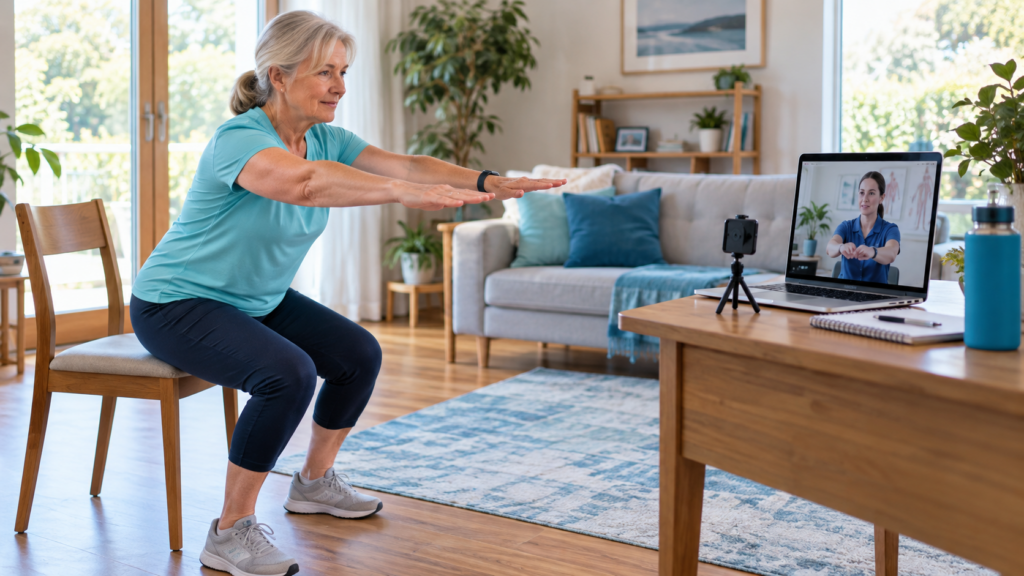
Selected timed and functional tasks may be considered where evidence, physical setup and supervision permit. Balance, transfers and fall-risk assessments demand particular caution.
Speech-language therapy
Communication interviews, selected tasks and AAC access observation may be feasible, but audio quality, latency and standardized administration affect interpretation.
Neuropsychology and cognition
Some remote cognitive instruments have modality-specific evidence; others cannot be treated as equivalent to in-person versions. Distraction, unauthorized prompting and test-security issues must be addressed.
Pediatrics
Developmental needs, assent, caregiver support and limited remote validation evidence are particularly important. Avoid drawing diagnostic conclusions from an improvised video game.
Camera setup, environment and protocol
Confirm identity and consent through approved processes. Check a stable device, adequate lighting, camera distance and framing, microphone, accessible interface and a fallback channel. Ask about available floor space and whether a caregiver is needed for setup or safety. Record deviations from protocol, technology failures, footwear, furniture and assistive devices when these could affect results. Do not ask patients to undertake unsafe standing or balance tasks without an individualized safety plan.
Motion capture, VR metrics and AI
Camera pose estimation, inertial sensors, VR controllers and interactive games may quantify movement timing, repetitions, trajectories, joint-angle estimates or task errors. Yet tracking accuracy may vary with occlusion, skin and clothing contrast, camera calibration, lens perspective, frame rate, device position and individual movement patterns. These metrics are not automatically equivalent to a goniometer, instrumented laboratory system or validated clinical scale.
AI can assist with summarizing observations, checking data completeness and creating accessible reports. The augmented therapist must understand the underlying measurement limitations and retain responsibility for interpretation. AI-generated assessment tools or low-code prototypes need technical validation, appropriate clinical studies, cybersecurity and regulatory review before being used to make clinical claims.
Remotion and therapist-led assessment
Remotion’s therapist-centred digital rehabilitation activities can generate selected performance information useful for clinical discussion, while Remotion TheraVerse allows clinicians to configure virtual rooms and arrange interactive objects with visual, auditory and hardware-compatible vibration cues. In any assessment context, these signals should be treated according to their actual validation status and intended purpose. A response to a virtual object or improvement in game accuracy is not itself proof of an improved real-world function or a validated diagnostic measure.
A step-by-step teleassessment workflow
- Define the clinical question and why remote assessment is appropriate.
- Select a measure supported for the population and remote administration mode.
- Screen clinical risk, consent, communication and access needs.
- Prepare equipment, environment, camera framing and assistance.
- Use consistent instructions and document any deviations.
- Interpret uncertainty, missing information and technical limitations.
- Compare findings with real-life goals and other clinical evidence.
- Arrange physical examination or referral where necessary.
- Secure data and schedule reassessment using comparable methods.
Case examples
Post-stroke upper-limb follow-up
A therapist observes an agreed reaching activity through video and compares it with a real-life kitchen goal. Scores from an interactive exercise support discussion but do not replace validated assessment or hands-on examination when indicated.
Child’s morning routine
An occupational therapist observes schoolbag preparation with family consent. The camera captures the environment and cueing needs; the result is interpreted as contextual observation, not a standardized developmental test.
Older adult and mobility
The team considers whether a functional task can be performed safely with adequate supervision. New instability or concerning symptoms trigger in-person evaluation rather than continuing the remote protocol.
Regulatory overview: Europe, USA and the Middle East
European Union
The GDPR governs personal and health-data processing. Clinical assessment software with a medical intended purpose may fall under MDR 2017/745; MDCG 2019-11 rev.1 explains software qualification and classification. The EU AI Act may also apply based on system characteristics and risk, with application dates and legislative changes to verify.
United States
The FDA evaluates software functions according to their intended medical purpose; guidance addresses clinical decision-support boundaries. HIPAA applies to covered entities and business associates in defined circumstances, not every wellness app. FTC rules and state telehealth/licensure laws may additionally apply.
Middle East
Rules differ by jurisdiction. Saudi Arabia: SFDA digital health product rules and Saudi data protection requirements. United Arab Emirates: applicable medical-product requirements and Federal Law No. 2 of 2019 regarding ICT in health fields. Qatar: Personal Data Privacy Protection Law No. 13 of 2016 and relevant health authority rules. Cross-border practice, cloud hosting and data transfers require local review. A generic video call, an educational game and diagnostic AI software may face different requirements.
This is a regulatory orientation, not a legal classification or professional legal opinion.
Consent, privacy and fairness
Remote assessment can expose private rooms, household members, voice, movement and identifiable medical data. Use secure approved channels, minimize recording, explain access and retention, and respect patient autonomy and pediatric safeguarding. Consider limitations caused by weak connectivity, sensory impairment, language barriers, low digital literacy or an unavailable caregiver. Offer accessible alternatives and document modality-related uncertainty.
Frequently asked questions
Can all standardized assessments be administered by video?
No. Check the instrument’s specific instructions, licensing and remote measurement evidence.
Are AI-estimated joint angles clinically accurate?
Not by default. Accuracy depends on the system, validation, task and conditions.
Can parents perform remote pediatric assessments alone?
They can support clinician-directed observation, but standardized assessment, diagnosis and safety-sensitive interpretation require appropriate expertise.
What if the connection fails?
Pause, document the issue, use an agreed fallback and repeat or reschedule when measurement quality is inadequate.
When is in-person assessment necessary?
When physical examination, safety, standardized administration or diagnostic uncertainty requires direct review.
Conclusion and further reading
Remote assessment can reveal daily-life context and support continuity, but only when the selected methods are fit for purpose. Therapists should combine measurement science, clinical reasoning, accessibility and data protection, using AI and immersive technologies as aids rather than substitutes for validated assessment.
Read also: Telerehabilitation: Definition and Evidence, Hybrid Rehabilitation Pathways and Tracking Progress Without Over-Monitoring.
References
- Klein T et al. Remote assessment of physical fitness via videoconferencing: a systematic review, 2025.
- Baroni A et al. Clinical utility of remote teleassessment of motor performance in neurological disabilities, 2025.
- Sauerzopf L et al. Remotely assessing upper-extremity motor function after stroke, 2024.
- European Commission. MDCG 2019-11 rev.1, 2025.