

Introduction
Hand and upper-limb rehabilitation aims to improve meaningful use of the shoulder, elbow, wrist and fingers in everyday life. Following stroke, injury, surgery or neurological disease, digital tools can complement therapist-directed assessment and task-specific practice. Camera tracking, wearable sensors, virtual reality (VR), interactive games and artificial intelligence (AI) can generate feedback, but usefulness depends on diagnosis, healing stage, safety and real-world outcomes.
Why the cause of impairment matters
Rehabilitation after stroke differs from management following a tendon repair, fracture, peripheral nerve injury, arthritis or overuse syndrome. Immobilization requirements, tissue healing and surgical precautions may prohibit movements that a general gaming application would encourage. A qualified professional should determine whether active movement, resistance, grasping or weight bearing is appropriate. No generic digital programme should bypass a surgeon’s or therapist’s restrictions.
Assess function before selecting a tool
Clarify pain, swelling, edema, sensation, range of motion, strength, coordination, dexterity, fatigue, cognition and the person’s priorities. Consider activities such as eating, grooming, preparing meals, writing, computer use, dressing, work and hobbies. Distinguish measurements of a body function from the ability to complete a real occupation. Establish a clinically justified baseline and select standardized measures relevant to the diagnosis.
Evidence for VR and interactive rehabilitation
A 2025 Cochrane review of VR after stroke included 190 studies with 7,188 participants. VR may slightly improve upper-limb function compared with alternative treatment; adding VR to usual care probably improves upper-limb function, though study quality and intervention heterogeneity limit certainty. Most studies did not use fully immersive headsets. These results are specific to the stroke literature and must not be extrapolated to postoperative hand rehabilitation or presented as validation of an individual product.
For non-neurological hand conditions, evidence and safety precautions depend on the specific pathology. Interactive practice may be engaging, but clinical effectiveness must be demonstrated with suitable comparative evidence and functional measures.
Task-oriented practice and occupational performance
Select exercises in relation to a valued activity: grasping utensils, manipulating coins, opening a container, using a mouse or dressing. Interactive tasks can offer graded repetitions and visual feedback, but improvements in game performance should be checked through actual task completion, assistance required, movement quality and patient-reported difficulty. Motivation matters, yet more repetitions are not automatically better when pain, fatigue or tissue protection are relevant.
Motor control, reach and shoulder-elbow function
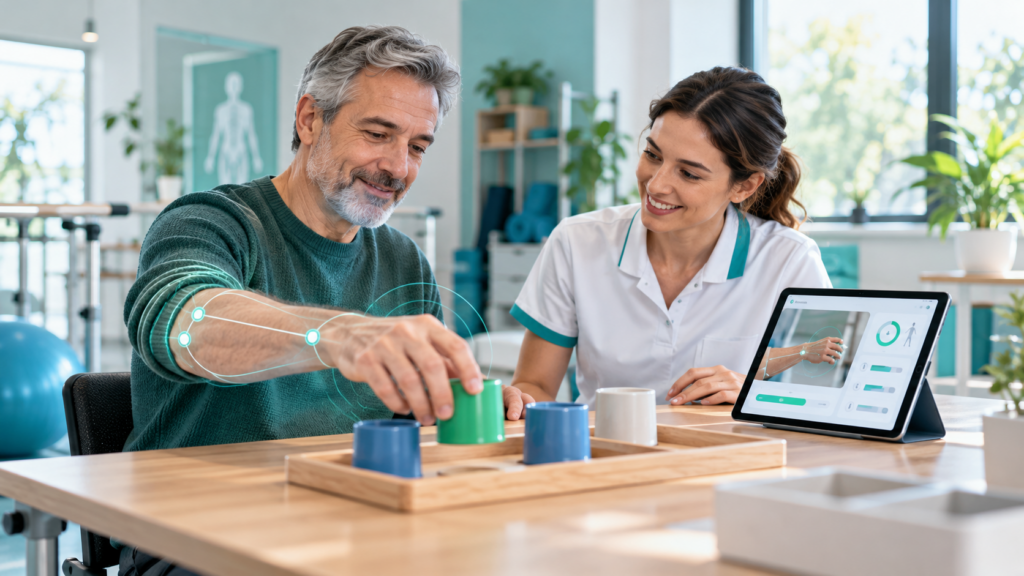
For suitable patients, reaching or object-placement activities can support selected practice goals. Therapists should watch for trunk compensation, shoulder elevation, pain, reduced control and unsafe movement. Camera-based trajectory data may supplement observations but do not necessarily measure anatomical joint motion precisely. Exercise intensity and feedback should be determined in context, not by a fixed algorithm.
Hand dexterity, grasp and fine-motor control
Hand rehabilitation often concerns pinch, grasp-release, finger individuation, coordination and manipulation. Some inexpensive tracking methods cannot reliably resolve finger joints, occluded hands or the forces applied during grasp. A touchscreen or controller may measure successful selection without reflecting grip force or fine manipulation. Clinicians should match the input modality to the construct being practised, and use instrumented devices only when their measurement properties are appropriate.
Motion capture and digital measurement limitations
Camera pose-estimation systems, VR controllers and inertial sensors may estimate repetitions, speed, movement paths and joint angles. Accuracy depends on calibration, camera placement, occlusion, skin and clothing contrast, frame rate and device fit. Hand tracking also varies with lighting, wrist rotation and overlapping fingers. A digital estimate is not automatically interchangeable with goniometry, grip dynamometry or a validated dexterity measure. Document device conditions and interpret longitudinal trends cautiously.
Outcome measures and meaningful change
Depending on the diagnosis and professional training, selected instruments might include the Action Research Arm Test (ARAT), Fugl-Meyer Assessment for post-stroke motor impairment, Box and Block Test, Nine-Hole Peg Test, dynamometry, or the Disabilities of the Arm, Shoulder and Hand questionnaire (DASH/QuickDASH). They assess different constructs and have different instructions, licenses and interpretation. Do not substitute game scores or remote administration without evidence of comparability. Track patient-defined occupational goals and adverse effects alongside measurement results.
VR, augmented reality and serious games
Non-immersive screens, projection, motion-sensitive devices and immersive headsets offer different opportunities and burdens. For upper-limb work, visual feedback can be useful, but visual-perceptual difficulties, cybersickness, fatigue, balance concerns and headset fit should shape modality choice. A person who needs to observe their physical hand may prefer a conventional screen or mixed-reality arrangement. The least complex clinically adequate tool may be best.
Therapist-led personalization with Remotion
Remotion Classic offers interactive rehabilitation activities across compatible devices under therapist guidance. Remotion TheraVerse provides clinician-configurable virtual rooms with interactive objects and visual, auditory and compatible vibration-based haptic cues. Therapists may adjust task demands for individualized practice. Neither these features nor the recording of game metrics proves effectiveness for a specific hand diagnosis or validates anatomical motion measurements. Clinical fit, safety and functional transfer must be evaluated.
AI and low-code development
AI can help therapists draft understandable instructions, generate accessible activity variations, prototype tailored games and organize appropriately protected observations. An augmented therapist uses such tools to extend—not relinquish—clinical reasoning. Generated software must be tested for accessibility, measurement accuracy, adverse consequences, cybersecurity, privacy and applicable medical-device rules. Unvalidated AI should not independently prescribe exercise doses, interpret tendon healing or diagnose neurological change.
Home programmes and hybrid follow-up
Some activities can be practised at home after clear assessment and instruction; others require hands-on treatment, equipment fitting or supervised movement. A hybrid pathway may use in-person evaluation, selected remote coaching and periodic functional review. The care team should define stopping criteria, pain or swelling escalation, technology failure procedures and the responsibilities of caregivers. Generic app reminders must not override clinical precautions.
Three clinical examples
Post-stroke meal preparation
A person wants to manage breakfast with their affected arm. The therapist selects appropriate reaching and manipulation practice and checks actual kitchen safety and independence rather than relying solely on game points.
Wrist fracture rehabilitation
After medical clearance for the relevant healing stage, a therapist may add an appropriate digital movement activity. The plan respects immobilization and load restrictions; unsupervised resistance is not inferred from successful game performance.
Hand dexterity and work participation
An individual wants to return to computer-based work. The team assesses fatigue, ergonomic setup, hand function and symptom response. Interactive tasks supplement graded real-world practice and workplace adaptations.
These are illustrative scenarios, not patient-specific prescriptions.
Safety, privacy and international regulatory considerations
European Union
The GDPR governs personal and health-data processing. Software with a medical intended purpose may be regulated under MDR 2017/745; applicable AI functions may also trigger obligations under the EU AI Act. Implementation dates, intended-use claims and national health-data rules require verification.
United States
FDA oversight depends on medical intended use and applicable exclusions. HIPAA applies to defined covered entities and business associates, while FTC and state rules can apply to other health technologies. Professional licensing and remote care rules vary.
Middle East
Requirements must be assessed country by country: Saudi Arabia has SFDA digital-health requirements and personal-data protection; the UAE has relevant medical-product and health information rules, including Federal Law No. 2 of 2019; Qatar has Personal Data Privacy Protection Law No. 13 of 2016 and health-sector requirements. Cloud hosting, cross-border data transfers and clinical claims warrant local review.
An exercise game, a diagnostic hand-tracking tool and software giving individual treatment recommendations may have different regulatory statuses. This section is informational, not legal advice.
Frequently asked questions
Can a VR game replace hand therapy?
No. It may complement selected professional interventions but cannot replace assessment, tissue precautions or task-specific rehabilitation.
Are camera-estimated finger angles clinically accurate?
Not automatically. Accuracy varies with equipment, setup, movement and validation.
Does more game practice mean faster recovery?
Not necessarily. Dose must match condition, tolerance and healing restrictions.
Can AI create a personalized hand exercise game?
It can assist with prototyping, but clinical suitability, safety, data protection and regulatory compliance need independent review.
What matters most when measuring outcomes?
Use clinically suitable measures and check meaningful daily hand function, pain, comfort and participation.
Conclusion and references
Digital technologies can expand upper-limb and hand rehabilitation when they address a defined functional goal and are supervised by appropriately qualified professionals. Motion tracking, games, VR and AI should support patient choice, task-oriented practice and meaningful outcomes—not replace diagnosis-specific safeguards or clinically validated measurements.
Related reading: Stroke Rehabilitation and Digital Technologies; Remote Assessment in Rehabilitation.
- Laver KE et al. Virtual reality for stroke rehabilitation. Cochrane, 2025.
- Interventions to improve arm and hand function after stroke. Cochrane.
- World Health Organization. International Classification of Functioning, Disability and Health.