

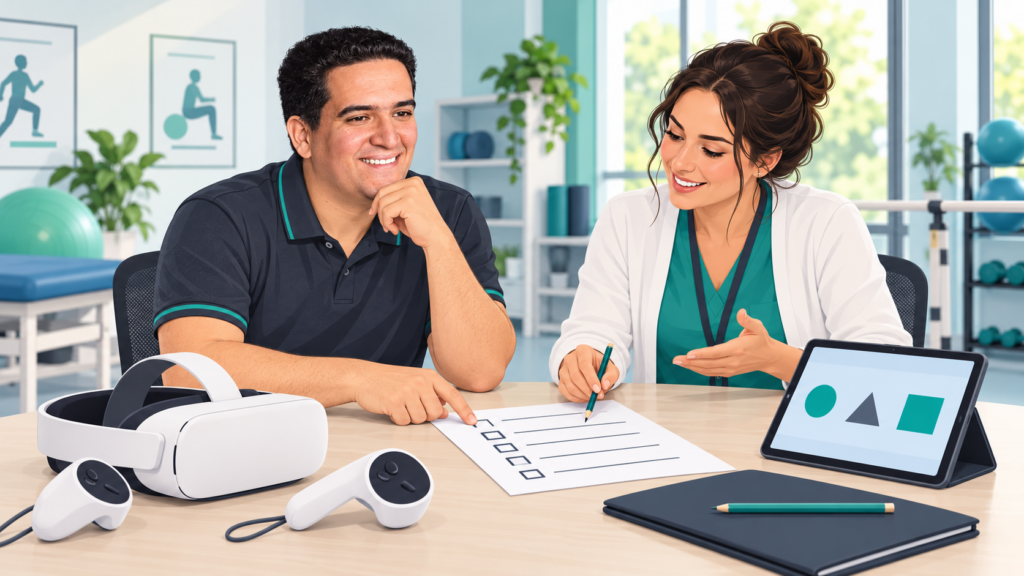
A convincing demonstration can show how a digital activity works. It cannot, on its own, establish whether the solution fits your patients, staff, room, information systems or budget. A useful buying decision starts with a clearly defined need and a consistent way to examine the proposed response.
This article offers an original discussion checklist for rehabilitation teams. It is not a product ranking, a validated scoring instrument or a substitute for the institution’s purchasing and review processes.
Write the need before comparing features
Describe the intended users, activity and setting. What difficulty should the solution address? What will it add to current practice, and who will operate it? Identify essential requirements separately from desirable extras.
For example, a team may need an accessible seated choice-making activity with a clear session summary. A large exercise catalogue is less relevant if the required input method is unavailable. Avoid letting the demonstration redefine the need without a deliberate team decision.
Examine the exact configuration being offered
Ask for the product name, software version, hardware, included activities and intended use in writing. Separate functions available now from development plans and optional modules. Verify what changes if you use a different headset, screen or input method.
For any regulatory statement, request the current documents relevant to the exact product and proposed use, and have the appropriate institutional reviewer examine them. A mark or general company statement does not establish that every activity is appropriate or clinically effective for every person.
Match evidence to the claim
Ask what evidence supports the specific benefit being proposed. Compare the studied population, activity, equipment, supervision and outcome with your intended use. A study about virtual reality in general does not establish the effect of every product using a headset.
NICE’s evidence standards framework can inform evaluation of digital health technologies. It links evidence expectations to intended purpose; meeting the framework does not mean NICE endorsement or regulatory approval. It is a UK framework, not automatic authorisation for use elsewhere. [1]
Distinguish engagement, task performance and clinically meaningful change. A high game score, positive testimonial or accurate-looking avatar answers a different question from a demonstrated improvement in daily participation.
Ask for a demonstration that reflects your workflow
Use agreed scenarios rather than only the supplier’s most polished example. Ask someone from your team to try preparation, configuration, pause, review and shutdown. Start with fictional information and an appropriate nonclinical demonstration.
Check what happens when an input is missed, tracking fails or connectivity is interrupted. Explore access needs, language, readable instructions and the way to stop. Confirm whether the proposed accommodations actually work in the offered version.
Use a structured discussion grid
| Area | Question to resolve before commitment |
|---|---|
| Intended use | Which people, activities and settings does the offered configuration support? |
| Evidence | Which product-specific claims are supported, and which remain uncertain? |
| Accessibility | Can intended users perceive instructions and feedback and use the controls? |
| Workflow | Who prepares, supervises, cleans, documents and maintains the system? |
| Outputs | What is measured, in which units, and what can be exported and interpreted? |
| Data | Which data are collected, where do they go and who can access them? |
| Support | What training, response arrangements, updates and repair services are included? |
| Cost | What is included now, recurrent, optional or payable separately? |
| Exit | What happens to access, exports, data and equipment when the agreement ends? |
Record an answer, its supporting document, unresolved points and the person responsible for follow-up. Do not hide a missing essential requirement inside a reassuring average score.
Review data handling and total cost
With the appropriate technical and data-protection contacts, map accounts, identifiers, recordings, hosting, access rights, retention, exports and deletion. Ask about service providers and remote support. CNIL recommends examining processors’ security guarantees and measures; a general reassurance is not enough for the organisation’s assessment. [2]
Build a cost comparison over the same chosen period. Include hardware, licences, installation, staff time, training, consumables, cleaning, maintenance, connectivity and potential replacements where relevant. Request the written scope of updates and paid services, without assuming that future development is included or can already be priced precisely.
Agree on what a trial can decide
If a trial is appropriate, define its purpose, responsibilities, duration, observations and decision criteria in advance. Clinical use needs suitable oversight and the institution’s applicable procedures. A short local trial can examine feasibility and acceptability; it does not automatically demonstrate clinical effectiveness.
End with a documented decision: purchase for a defined scope, request information, adapt the proposal, extend evaluation or decline. The strongest choice is the one that fits a verified need with understood limits and manageable implementation.
Ask the Remotion team for a configuration-specific demonstration and written proposal through the website contact page. Apply the same evaluation criteria to Remotion as to any other supplier.
References
- NICE. Evidence standards framework for digital health technologies. Overview and limitations: https://www.nice.org.uk/what-nice-does/digital-health/evidence-standards-framework-esf-for-digital-health-technologies . User guidance: https://www.nice.org.uk/corporate/ecd7/resources/evidence-standards-framework-for-digital-health-technologies-user-guide-9024813901/chapter/how-to-use-the-framework
- CNIL. Sécurité : Gérer la sous-traitance. https://www.cnil.fr/fr/securite-gerer-la-sous-traitance