

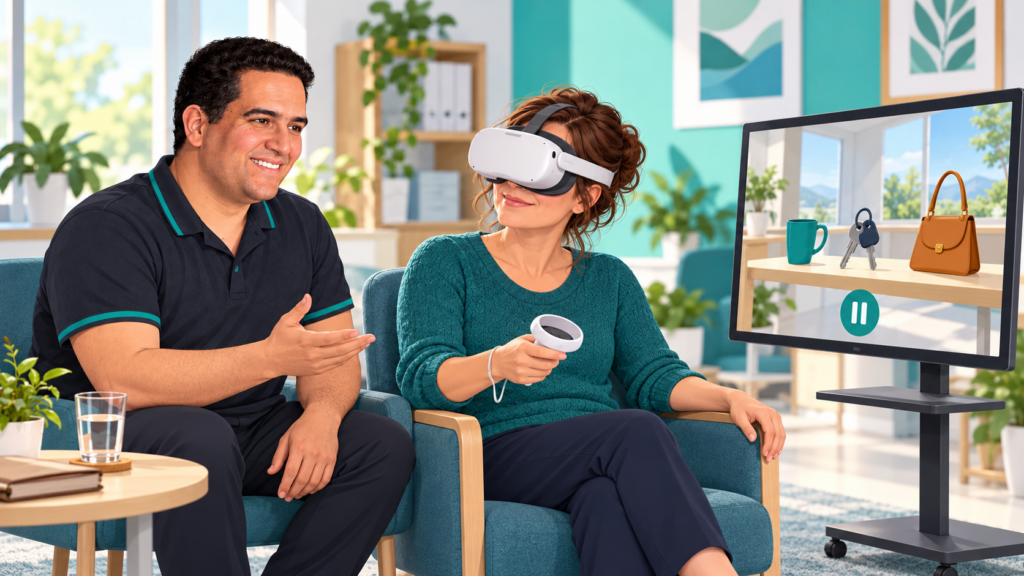
An immersive environment can provide a setting for selected rehabilitation tasks, such as making a choice or practising an assessed movement. For someone living with multiple sclerosis (MS), its relevance depends on the goal, current symptoms, access and the demands of wearing and using the equipment.
The question is not how long a person can remain inside a headset. It is whether VR helps them participate in a useful activity under suitable conditions. A successful session may include simplifying the task, taking a pause or choosing another medium.
Begin with a meaningful goal
Identify what matters outside the virtual scene: organising an outing, selecting relevant objects or carrying out a particular movement during an everyday task. State what will be practised and what information would support the next clinical decision.
Do not assume that everyone with MS has the same movement, visual, cognitive or fatigue-related needs. Review the person’s situation before each session. New, unexpected or worsening symptoms need appropriate clinical assessment rather than interpretation through a game score.
Consider fatigue without making assumptions
NICE recommends asking about fatigue and its impact, considering other possible causes and discussing personalised management. It also notes that heat can bring on MS-related fatigue. [1] These recommendations inform clinical planning; they do not show that a VR session treats fatigue.
Discuss timing, the effort of getting to the session and what the person needs to do afterwards. Wearing a headset, learning the controls and processing a busy scene can add demands beyond the intended exercise. Check comfort during the activity and after leaving VR, rather than relying only on enthusiasm while playing.
Avoid using a fixed duration or repetition target as a universal prescription. The appropriate activity, effort and pause arrangements require individual judgement within the rehabilitation plan.
Assess access and headset tolerance separately
Establish whether the person can perceive the scene, understand instructions and use the proposed input. A controller’s grip and trigger may be a barrier even when the person understands the task. Confirm any alternative input in the actual software; do not assume that hand tracking solves the problem.
Check seating or standing support, fit, visual comfort and communication. Keep the physical area clear and agree on a usable way to pause or stop. The therapist needs to observe the person, not only the mirrored virtual view.
Pause or stop for concerning symptoms, dizziness, nausea, visual discomfort, loss of safe control or a request to end. Decide on appropriate follow-up according to the situation. Discomfort should not be treated as something the person must push through to complete the game.
What does the immersive VR evidence show?
A small randomised feasibility study with 18 participants examined an immersive VR exergame programme for people with MS and reported favourable feasibility and user-experience findings. [2] This is evidence about that programme in its study setting, not definitive proof of sustained benefit or suitability for everyone.
When reading other VR studies, check whether they used an immersive headset, a semi-immersive display or screen-based games. Their demands differ. Findings cannot automatically be transferred to another application or to a Remotion configuration. Feasibility, enjoyment, clinical effectiveness and disease progression are separate questions.
Example: organising objects for an outing
This original example is for a qualified clinician and an adult assessed as suitable for supervised seated VR. It is not a validated MS intervention or a home-exercise programme.
| Planning element | Illustrative approach |
|---|---|
| Objective | Make purposeful selections connected with preparing an everyday outing. |
| Context | Individual supervised session with an agreed fatigue and comfort review. |
| Task | Choose relevant virtual objects using an accessible response. |
| Configuration | Where supported, adjust choices, scene complexity, target location, prompts and timing. |
| Observations | Choices, errors, assistance, comfort, pauses and the person’s account of effort. |
| Easier version | Fewer choices, less visual activity, simpler input or a non-headset alternative. |
| Progression | Change one relevant demand when justified, with another access and tolerance check. |
| Cautions | Monitor symptoms and safe control; use the agreed stop method without pressure to finish. |
| Documentation | Record the objective, setup, settings, help, perceived effort and next decision. |
These are planning possibilities, not confirmed features of every Remotion configuration. Real-object practice follows an appropriate transition out of VR; do not ask the person to reach for untracked physical items while their view is obscured.
Measure what the session can actually tell you
Keep software-recorded events distinct from clinical observations and the person’s experience. Fewer targets completed on a different day do not, by themselves, demonstrate disease progression. A higher score does not establish reduced fatigue or greater independence.
Document changes in instructions, assistance, input, scene and positioning when comparing sessions. Use appropriate clinical assessments and follow-up if the question concerns function or fatigue. Ask whether the activity supports the person’s priorities and leaves room for the rest of their day.
VR can be considered as one medium within coordinated rehabilitation. It does not replace MS medical management or establish a treatment effect merely by creating an immersive experience.
Discuss your goals and setting with the Remotion team through the website contact page. Confirm the specific configuration’s intended use and access options; this article does not establish an MS-specific benefit for Remotion.
References
- NICE. Multiple sclerosis in adults: management. NG220. Recommendations, fatigue section. https://www.nice.org.uk/guidance/ng220/chapter/Recommendations
- Exergames and Immersive Virtual Reality as a Novel Therapy Approach in Multiple Sclerosis: Randomised Feasibility Study. 2024. PMID 39407905. https://pubmed.ncbi.nlm.nih.gov/39407905/