

مقدمة
Home-based therapeutic exercise can extend rehabilitation beyond the clinic, but an effective programme is more than a collection of online movements. It connects a person’s goals with appropriate exercises, functional activities, supervision and periodic review. Smartphones, video guidance, wearables and interactive platforms may help deliver feedback. Their usefulness depends on safe personalization, measurement quality and clinical follow-up—not the amount of data collected.
What counts as therapeutic home exercise?
A therapeutic home programme is selected, instructed and reviewed by a qualified professional for an individual clinical purpose. It may include strength, mobility, coordination, balance, upper-limb function, breathing-related activity or task-specific practice. Meaningful occupations—dressing, reaching for objects, moving around a home, preparing food or participating in play—can be as important as isolated exercises. Exercise type, load, dosage, precautions and progression must be tailored to the individual’s condition and risk profile.
Start with clinical goals and baseline
Agree on the activity the person wishes to improve. Assess current ability, assistance needs, pain, fatigue, movement safety, cognition, access and environmental barriers. Record a baseline using clinically suitable instruments where possible. Do not choose an activity merely because an app can measure it. Document both the desired functional change and the observations that may inform it.
What makes a programme sustainable?
The plan should explain what to do, how to perform the activity, how often according to clinical advice, what equipment and supervision are required, how to modify the task and when to stop. Integrating appropriate practice into ordinary routines can reduce burden. Progression is not simply increasing repetitions: it may involve less assistance, better quality, improved confidence or transfer to everyday activities. Rest and preferences are part of individualized care.
Five ways to support home activities
1. Clear instructions
Accessible written steps, a simple video or a visual routine can support understanding. Demonstrations should show the intended setup, task and safety boundaries.
2. Remote coaching
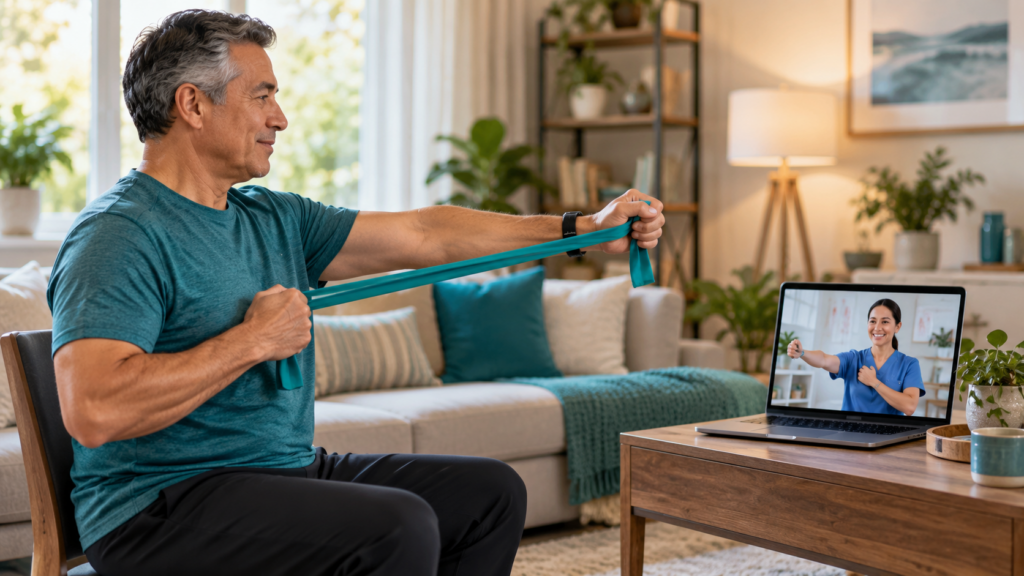
Secure video appointments can help clinicians observe selected activities and adapt instructions. Camera framing, latency and an agreed plan for unsafe tasks are important.
3. Interactive practice
Therapist-selected games may encourage repetition, attention or motor activity. Scores are practice indicators, not automatic evidence of functional improvement.
4. Wearable and camera sensors
Devices may estimate steps, movement timing, repetitions or range of motion. Their accuracy and clinical validity depend on the technology and intended task.
5. Follow-up and shared review
Brief check-ins can identify barriers, fatigue, frustration or changes in performance and determine whether a face-to-face reassessment is needed.
Monitoring: what matters and what does not
Useful categories include activity performance, assistance required, participation, patient-reported comfort and selected validated clinical measures. Sensor data such as repetitions, movement trajectories, heart rate or task accuracy may complement—but cannot replace—clinical evaluation. More daily measurements can create anxiety, privacy risks and caregiver workload. Choose a limited set of indicators and a review schedule matched to the clinical decision.
Motion tracking, wearables and technical limitations
Camera pose-estimation systems can lose track when limbs are occluded or lighting and camera angles change. Wearables may show drift, placement errors or variability between devices. VR controllers measure their own tracked position, not necessarily an anatomically accurate joint angle. Algorithms can misclassify compensatory movements as correct practice. Clinicians should understand sensor calibration, accuracy, validity and whether performance improvements transfer to real-world function. An automatically generated number is not a diagnosis.
AI and therapist-created personalized tools
AI can help clinicians draft accessible instructions, generate visual schedules, summarize non-sensitive observations and prototype interactive educational activities. Therapists increasingly need AI and digital literacy to create or co-design tools that fit a person’s functional needs rather than forcing everyone into fixed content. An occupational therapist might prototype a configurable sequencing game; a physiotherapist might define a safe movement-feedback interface for subsequent validation.
AI-assisted coding can accelerate development, but software that functions technically is not automatically safe, effective, secure or eligible for use as a medical device. Clinicians and developers should test accessibility and usability, evaluate clinical risk, protect data and clarify the intended purpose before clinical deployment. Automated AI decisions should not independently change treatment dosage or interpret deterioration without suitable validation and oversight.
Remotion Classic and TheraVerse in a home pathway
Remotion Classic offers therapist-centred interactive rehabilitation activities across supported devices. Remotion TheraVerse explores therapist-configurable virtual environments in which interactive objects can be placed in a virtual room and combined with visual, auditory and vibration-based haptic feedback through compatible hardware. Such tools may contribute to individualized activities when professional supervision, equipment, access and safety conditions are appropriate. Availability of a digital environment does not by itself establish that an exercise can safely be performed without supervision or that its outcomes are clinically validated.
Safety and escalation
Screen for factors such as unstable symptoms, fall risk, pain, cardiovascular concerns, fatigue, cognitive or communication barriers, seizure-related precautions where relevant, and the home environment. Activities involving complex transfers or challenging balance may need in-person assessment and supervision. Stop when concerning symptoms, unsafe movement or significant discomfort occurs and contact the care team. Sudden stroke-like symptoms, severe chest pain, significant breathing difficulty or collapse require emergency medical services rather than continued exercise or digital messaging.
Do not provide universal exercise doses or encourage patients to increase difficulty based only on an app score.
Three illustrative scenarios
Adult recovering after stroke
Following clinical assessment, a person works toward preparing a simple drink. Selected upper-limb activities may be supported by interactive exercises, while the therapist reviews actual task performance, safety and the assistance required.
Child practising daily routines
A family and occupational therapist agree on schoolbag organization and appropriate motor tasks. A visual schedule or simple game supports practice. The child’s comfort and participation, not screen time, define meaningful progress.
Older adult maintaining mobility
A clinician selects an appropriate home activity programme after evaluating balance and risk. A wearable may provide contextual information, but changes in safe community participation and required assistance guide reassessment.
These scenarios explain clinical reasoning; they are not individual prescriptions.
Privacy and international regulatory considerations
European Union
The قانون حماية البيانات الشخصية governs personal-data processing with additional rules for health data. Software intended for a medical purpose may qualify under MDR 2017/745. The EU AI Act may impose AI-specific obligations depending on intended use and risk; implementation schedules and amendments should be verified against current official information.
United States
The FDA evaluates functions according to medical intended use and applicable exclusions; certain coaching functions are treated differently from software that provides patient-specific treatment recommendations. HIPAA applies to defined covered entities and business associates, not automatically every consumer app; FTC and state privacy rules may also matter.
Middle East
There is no single regional framework. In Saudi Arabia, review SFDA digital-health guidance and personal-data rules; in the UAE, applicable medical-device pathways and health information requirements including Federal Law No. 2 of 2019; and in Qatar, Personal Data Privacy Protection Law No. 13 of 2016 alongside local healthcare requirements. Cloud hosting and cross-border transfer rules warrant specific review.
Distinguish a generic educational exercise guide from regulated software claiming to prescribe treatment, assess disease or make clinical decisions. This summary is educational, not legal advice.
Practical checklist for patients and professionals
- Choose a meaningful activity goal with the person.
- Confirm the clinician-approved exercise plan, dosage and stopping rules.
- Check physical environment, devices and accessibility.
- Define who provides assistance and when.
- Explain what data are collected and how they will be protected.
- Measure functional change using appropriate methods.
- Review fatigue, comfort, adherence and caregiver burden.
- Reassess in person when remote observation is insufficient.
الأسئلة الشائعة
Can a general fitness app replace a home rehabilitation plan?
No. Individual clinical goals, risk assessment and professional guidance may be necessary.
Does recording more repetitions mean better rehabilitation?
Not necessarily. Quality, safety, functional transfer and meaningful outcomes matter.
Are camera-estimated joint angles reliable?
Reliability varies by system, movement and conditions. Do not treat all estimates as validated clinical measurements.
Can AI personalize exercises automatically?
AI can help prepare options but treatment decisions and safe progression need appropriate validation and professional oversight.
How should families report progress?
Use an agreed, manageable method focused on real daily activities rather than continuous monitoring.
خاتمة
The strongest home programme is not the one with the most sensors or the greatest number of exercises. It is the plan that supports meaningful function, can be sustained safely and is reviewed in partnership with the person. Interactive tools, AI and remote monitoring can extend professional capabilities when their limitations are understood and clinical judgment remains central.
Related reading: Designing Effective Hybrid Rehabilitation Pathways, Remote Assessment in Rehabilitation, ، و Tracking Progress Without Over-Monitoring.
References and further reading
- WHO. Rehabilitation.
- WHO. Monitoring and evaluating digital health interventions.
- US FDA. Policy for Device Software Functions and Mobile Medical Applications.
- European Union. قانون حماية البيانات الشخصية, MDR.