

مقدمة
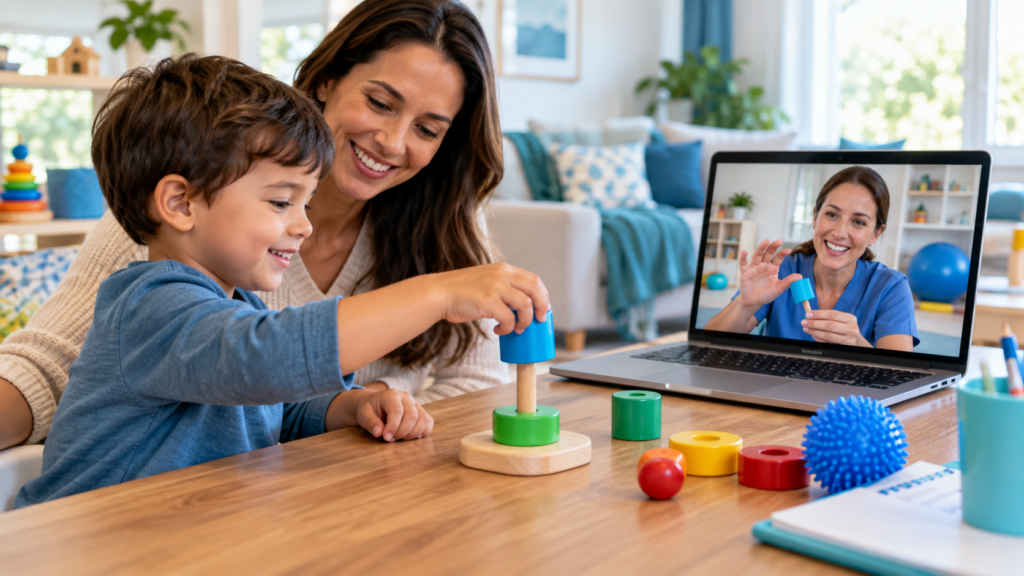
Remote rehabilitation can connect pediatric therapists with children and families beyond clinic walls, including in the environments where dressing, play, communication, learning and social participation actually occur. It can reduce travel and support continuity, but it can also transfer significant work to caregivers and create barriers for families with limited devices, privacy or connectivity. A responsible pediatric teletherapy pathway puts the child’s participation, safety, communication and family priorities before technology.
What is pediatric telerehabilitation?
Pediatric telerehabilitation means delivering selected rehabilitation assessment, therapy, education, coaching or follow-up through communication technologies when the clinician and child are in different locations. It may use live video sessions, asynchronous therapist-guided activities, secure communication, and hybrid care combining in-person appointments and remote support. It is not equivalent to leaving a child unsupervised with a game or replacing clinical assessment with automated scores. WHO guidance on teleconsultations with children and families gives practical considerations for organizing this form of care.
What does research tell us?
Pediatric telehealth research suggests opportunities for selected rehabilitation and family-coaching activities, but findings vary by intervention, diagnosis, age, outcome and access. A 2021 narrative review of pediatric rehabilitation telehealth described useful applications and gaps in evidence. A 2024 scoping review of 34 studies identified caregiver roles ranging from technical support and implementation to collaboration and supervision; this is a reminder that teletherapy is not workload-free. A 2023 scoping review of caregiver outcomes found encouraging reports but called for stronger measurement methods. A 2026 systematic review of digital pediatric physiotherapy interventions also described fragmented evidence and the need for coherent family-centred pathways. None of this supports a blanket claim that remote sessions replace every in-person examination. Pediatric rehabilitation review; Caregiver roles review; Caregiver outcomes review.
Which children and goals may benefit?
Potential applications include occupational therapy for everyday routines, physiotherapy follow-up for selected movement goals, speech-language therapy and AAC coaching, parent education, selected cognitive or executive-function supports, and participation-related goals at home or school. Suitability depends on clinical condition, developmental age, attention, sensory comfort, communication, risk, consent, resources and the child’s own preferences. A remote model is not an automatic fit for children with complex physical handling needs, unstable symptoms or assessments requiring direct physical examination.
Family-centred care, without making parents substitute therapists
Families know the child’s environments, routines and interests. They can help clarify priorities and provide feedback, but care plans must respect employment, fatigue, siblings, financial constraints and other responsibilities. Parents may act as facilitators, technicians, collaborators or coaches depending on the intervention; professionals should never assume unlimited capacity. Explain precisely who will set up the device, support the task, observe warning signs and contact the clinician. Caregiver coaching should be supportive, not an implicit transfer of clinical accountability.
Child voice, assent and shared decisions
Even when a parent or guardian provides legally valid consent, the child’s preferences, discomfort, assent and refusal deserve attention appropriate to age and development. Offer choices in tasks, pace and interaction style. For adolescents, respect privacy and growing autonomy in clinical conversations. Consider how a child communicates through speech, gestures, symbols, AAC or behavior, and do not confuse silence with agreement.
A practical seven-stage pediatric remote pathway
- Clarify the meaningful goal: identify a participation target such as getting ready for school, playing with peers or requesting help.
- Assess suitability: review physical risk, attention, communication, sensory needs and whether in-person examination is needed.
- Plan access: test devices, internet, camera, sound, privacy and accessible alternatives.
- Agree roles: identify what the child, family and clinicians each do during and between sessions.
- Deliver brief, responsive activities: adapt pacing and cues to the child’s capacity rather than forcing a fixed screen schedule.
- Observe real-life change: combine functional observation with suitable standardized or reported outcomes.
- Review and adjust: consider burden, consent, safety and whether a hybrid or in-person modality is preferable.
Occupational therapy at home
An occupational therapist may observe feeding routines, dressing, handwriting setup, play, organization of school materials or household accessibility. Camera-based observation can reveal environmental constraints absent from the clinic. But the camera framing, prompts from caregivers and the child’s response to being filmed can alter performance. Contextual observation should not be presented as a standardized diagnostic test unless the instrument and administration method have appropriate evidence.
Physiotherapy, motor skills and safe movement
Remote physiotherapy can support selected education, movement demonstrations and home practice after suitable clinical assessment. Balance challenges, transfers, postural handling, falls risk and unstable medical presentations may require direct supervision or in-person assessment. Caregivers must not be asked to perform potentially unsafe manual handling without specific instruction and appropriate competency. Therapy dosage and progression should be clinically determined, not inferred from app scores.
Speech-language therapy, AAC and communication
Video sessions may support caregiver modelling of communication, language activities and AAC use within daily routines. Clinicians should consider microphone quality, processing delay, visual framing, language access and whether the communication system is available and configured. Remote assessments must respect each instrument’s standardization and validity requirements. If video causes communication barriers, use a better-supported modality.
Sensory needs, attention and screen burden
For some children, remote sessions are convenient; for others, screens, background motion, sounds, headsets or long instructions create overload. Adapt session length, contrast, lighting, cues and opportunities to pause. A sensory-friendly environment should be individualized rather than based on untested assumptions. Do not label every discomfort or distraction as poor motivation. Avoid claiming that consumer VR or vibration-based haptic feedback is a substitute for an evidence-based sensory integration intervention.
Digital games, VR and Remotion
Serious games and interactive exercises may help selected children participate in activities that are motivating and adaptable. Remotion Classic offers therapist-centred interactive rehabilitation activities across supported devices. Remotion TheraVerse supports therapist-configurable virtual environments with interactive objects and visual, auditory and vibration-based haptic cues on compatible equipment. A clinician may explore scenarios or adjust task demands, but actual hardware suitability, age recommendations, clinical supervision and safety must be established. Game scores are not automatically validated indicators of functional progress, and a VR headset should never be presumed suitable for every child.
AI and personalized pediatric support
AI may help therapists prepare visual schedules, simple educational materials, translated drafts for review and prototypes of accessible games or activities. Therapists should learn to evaluate AI systems and, where useful, co-design low-code tools for specific functional needs. An AI-generated activity must be checked for age appropriateness, bias, accessibility, privacy, technical performance and clinical relevance. Patient records should not be entered into general-purpose AI services without approved data safeguards. AI must not independently diagnose developmental conditions or adjust therapeutic programmes based on unvalidated data.
Clinical outcomes: look beyond logins and game points
Measure activities that matter: initiating a request, taking part in play, completing a school preparation step, walking safely to an activity, or using communication support more effectively. Pair functional goals with appropriate clinical measures and family- or child-reported experiences. Ask whether the programme creates extra caregiver work, inequity, frustration or loss of autonomy. Logging in regularly is not the same as improving participation.
Privacy, safeguarding and regulatory considerations
European Union
The قانون حماية البيانات الشخصية governs personal-data handling, with specific safeguards for health and children’s data. Medical-purpose software may fall under MDR 2017/745; additional obligations may arise from the EU AI Act. Application timelines and legislative changes should be checked at deployment. Obtain appropriate authorization for health professional practice and cross-border care.
United States
The FDA may regulate software according to intended medical use. HIPAA applies in covered-entity and business-associate contexts, not to all consumer tools. Children’s data may also implicate COPPA for covered online services, along with state professional and privacy requirements.
Middle East
Assess rules market by market. Saudi Arabia has SFDA digital-health requirements and personal-data rules. The United Arab Emirates has medical-product requirements and health-information legislation, including Federal Law No. 2 of 2019 on ICT in health fields. Qatar has Personal Data Privacy Protection Law No. 13 of 2016 and applicable health authority requirements. Consent for minors, access to recordings, cross-border data transfers and professional authorization need local review.
Always distinguish an educational game from software making medical claims. This is an orientation, not legal advice.
Accessibility and digital inclusion
The 2024 WHO–ITU implementation toolkit highlights that telehealth can exclude people with disabilities when access needs are not designed in. Offer clear text, captions, accessible input methods, screen-reader support when relevant, multilingual resources and low-bandwidth alternatives. Families without a private room or reliable connection should have an appropriate non-digital or in-person path. Digital inclusion is part of clinical quality, not an optional product feature.
Three practical scenarios
Morning independence
A child and occupational therapist select a schoolbag routine as the goal. A caregiver helps position the camera, while the clinician observes which steps the child performs independently. A simple visual schedule is tested between reviews.
Early communication
A speech-language therapist coaches a family member on responding to a child’s communication during play. Short sessions prioritize real interactions and accessible communication rather than screen performance.
Motor participation
A physiotherapist assesses whether a movement activity is safe to practise at home. An interactive game may be used as supporting practice, but in-person reassessment is arranged when handling or balance risks warrant it.
These scenarios are illustrative, not individualized treatment plans.
الأسئلة الشائعة
Can telerehabilitation replace all pediatric clinic visits?
No. Some goals and assessments fit remote care; others require direct examination, handling or supervision.
Do parents need to become the child’s therapist?
No. Parents may support agreed activities within their capacity, while clinicians retain professional responsibility.
Are VR headsets appropriate for all children?
No. Assess device age guidance, clinical suitability, sensory comfort, safety and supervision.
Can AI diagnose or automatically prescribe pediatric therapy?
Not on the basis of an unvalidated app or chatbot. Any medical-purpose functionality requires appropriate evidence, oversight and regulatory assessment.
What if the family lacks technology?
Use an accessible alternative or in-person pathway rather than denying appropriate care.
Conclusion and references
Pediatric telerehabilitation is most useful when it brings professional expertise into meaningful routines without overburdening children and caregivers. Prioritize choice, shared decisions, clinical safety, accessibility and real-world participation over technology adoption. Hybrid models can combine the strengths of direct care with targeted remote support.
Related reading: Telerehabilitation for Families, Family-Centered Rehabilitation and Shared Decision-Making و Using VR Safely With Children.
- WHO. How to plan and conduct telehealth consultations with children and adolescents and their families (2021).
- WHO–ITU. Implementation toolkit for accessible telehealth services (2024).
- Tkach & Earwood. Caregiver roles in pediatric rehabilitation telehealth: scoping review.
- Measuring caregiver outcomes in pediatric rehabilitation telehealth services.
- Telehealth in Pediatric Rehabilitation (2021).