

Introduction
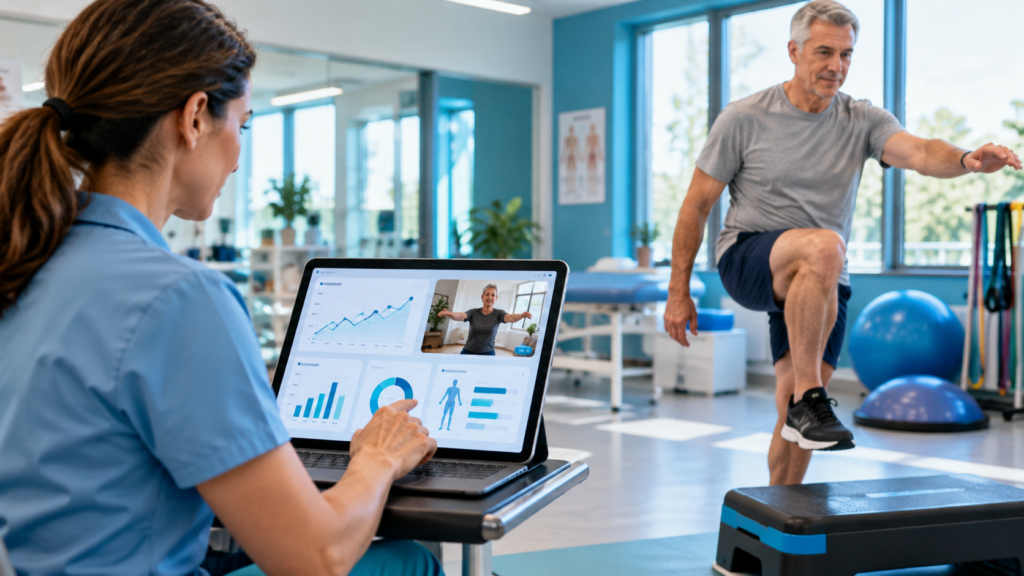
Hybrid rehabilitation blends in-person care with remote visits, therapist-guided activities and selected digital measurements. Measuring its success requires more than counting appointments, app sessions or repetitions. A clinically useful outcome framework asks whether people can do more of what matters in everyday life, whether gains are meaningful and safe, and whether the care pathway is accessible and sustainable. This guide outlines a practical approach to outcome measurement for clinicians, healthcare organizations and rehabilitation technology teams.
Distinguish clinical outcomes from process metrics
An outcome describes a change in functioning, health, participation or quality of life. A process metric records how care was delivered: video consultations, home exercise sessions, time on task or logins. Both may be worth monitoring, but they answer different questions. Ten completed game sessions do not demonstrate improved independent dressing, mobility or communication. A digital score becomes clinically meaningful only when its relationship to the intended construct and patient benefit is established.
Use the ICF to organize measurement
The World Health Organization’s International Classification of Functioning, Disability and Health (ICF) distinguishes body functions and structures, activities, participation and environmental factors. A hybrid programme can therefore measure more than a physical impairment: it can consider whether the person prepares meals, participates in school, communicates effectively or resumes meaningful community activities. Environmental accessibility, family support and assistive technology influence these outcomes.
A practical four-layer outcomes model
- Person-defined outcomes: a specific activity or participation goal, agreed with the person and reviewed together.
- Clinical measurement: condition-appropriate standardized tools with suitable validity, reliability and interpretation.
- Patient- or caregiver-reported outcomes: perceived difficulty, confidence, pain interference, fatigue, quality of life or burden.
- Service and digital indicators: access, technical failures, completion, adverse events, travel burden and sensor-derived measures where appropriate.
No single layer should substitute for the others. The framework should stay proportionate: more indicators can increase workload without increasing insight.
Choosing meaningful goals and measures
Start with a structured discussion: What matters to the person? What would count as a noticeable improvement? What assistance or environmental conditions affect performance? Document the baseline and select an agreed reassessment interval. Tools such as Goal Attainment Scaling or the Canadian Occupational Performance Measure may be considered by appropriately trained professionals when suitable to their intended population and use; administration, licensing and interpretation requirements must be followed. Avoid rewriting a validated instrument’s instructions simply to make it fit a video call.
Validity, reliability and responsiveness
Validity asks whether a measure reflects the intended construct. Reliability concerns consistency, and responsiveness concerns detecting change over time. Measurement error and minimal important change help separate fluctuations from changes meaningful to people, when credible estimates exist for that population and context. A tool validated face to face is not automatically validated for remote administration. Camera angle, caregiver cues, device differences, lighting and practice effects may influence results.
Patient-reported outcomes and experience
Patient-reported outcome measures (PROMs) can capture symptoms, daily function and perceived health without assuming the clinician or software knows what matters most. Patient-reported experience measures (PREMs) instead address care processes, such as communication, respect, accessibility and involvement in decisions. A family caregiver’s report can add context, but should not automatically replace an adult patient’s own view. Accessible formats and language adaptation are essential; machine translation alone does not establish a questionnaire’s psychometric equivalence.
What digital sensors and games can measure
Camera-based movement tracking, VR controllers, wearables and exercise software can provide estimated repetitions, motion trajectories, response times, accuracy, pauses and task completion. Such digital measures can support review if their quality and purpose are understood. Do not use the term digital biomarker indiscriminately: a digital signal should only be described as a biomarker when it has an adequately defined biological or clinical interpretation and appropriate validation for its intended context. Raw tracking data or a game score are not automatically clinical biomarkers.
How to compare in-person and remote measurements
Where a pathway alternates modalities, document how each measure was collected and whether both administration methods are comparable. Keep conditions consistent when feasible and record adaptations. If a balance assessment requires hands-on guarding, it should not be performed unsupervised merely to maintain a time series. When cross-modality equivalence is unsupported, present trends separately rather than merging numbers into a falsely precise progression curve.
AI-assisted reporting and therapist-led interpretation
AI may help draft accessible summaries, organize trends, flag missing entries for review or prototype patient-facing progress displays. Therapists increasingly benefit from AI and low-code literacy so they can specify and co-design tools for their own clinical populations. However, a generated graph or automated summary can hide uncertainty, propagate erroneous input or invent explanations. AI should not independently diagnose deterioration, prescribe progression or decide discharge from unvalidated data. Maintain human verification, clear provenance, data protection and appropriate regulatory review.
Remotion and clinically meaningful data
Remotion Classic provides therapist-centred interactive rehabilitation activities on supported devices. Remotion TheraVerse enables configurable virtual environments with interactive objects and visual, auditory and compatible vibration-based haptic cues. Interactive systems can provide selected task-performance signals, but those metrics must be interpreted within their actual validation status. A higher game score is not equivalent to independence in a real kitchen, classroom or community setting. Clinicians should combine digital information with observed participation and patient-defined goals.
Measure safety, equity and implementation quality
Outcome programmes should also track adverse events, unexpected fatigue, unsafe compensatory movements, disengagement attributable to poor accessibility, technical interruptions and caregiver workload. Examine whether certain groups cannot connect, use assistive technologies or complete remote tasks. Travel avoided and reduced waiting time may be valuable service outcomes, but should be reported separately from functional recovery and without assuming savings in every case.
Three illustrative pathways
Stroke: returning to meal preparation
The patient chooses preparing a simple breakfast as the priority. The team observes real task independence and uses condition-appropriate clinical assessments; selected game metrics explain practice rather than define success.
Child: school participation
The child and family select organizing a schoolbag and engaging in class routines. The therapist documents support needs and participation, while monitoring whether digital tools create sensory or caregiver burden.
Older adult: community mobility
The team reviews safe travel to social activities, confidence and assistance. Wearable step counts may add context, but they cannot independently establish safe or meaningful participation.
These cases illustrate outcome reasoning, not patient-specific medical advice.
International regulatory reminder
European Union
The GDPR governs processing of personal data, including specific safeguards for health information. Medical-purpose software may be regulated under MDR 2017/745. Depending on its intended use and risk, an AI system may be subject to the EU AI Act, with relevant application dates and amendments to verify at deployment. Health-data hosting and professional obligations may also be shaped by national law.
United States
The FDA evaluates software functions based on intended medical use and applicable exclusions. HIPAA applies to covered entities and business associates in defined contexts rather than every digital health product; FTC rules and state requirements may also apply.
Middle East
There is no unified regional regime. In Saudi Arabia, review SFDA digital-health and medical-device requirements and personal-data obligations. In the UAE, assess applicable healthcare-product rules and health-data regulation, including Federal Law No. 2 of 2019. In Qatar, consider Personal Data Privacy Protection Law No. 13 of 2016 and relevant healthcare authority rules. Cloud hosting, cross-border transfers, professional licensing and AI-based medical claims require market-specific evaluation.
A wellness dashboard, a validated clinical measure and software recommending individual treatment decisions may face different legal requirements. This section is informational, not legal advice.
A ten-point outcomes checklist
- Have we agreed on at least one meaningful participation goal?
- Have we recorded the baseline and intended review date?
- Are clinical measures suitable for this patient and delivery mode?
- Have we distinguished outcomes from usage metrics?
- Are important changes interpretable given measurement error?
- Have we included the person’s experience and preferences?
- Are safety, accessibility and caregiver burden considered?
- Are digital measures technically reliable enough for their purpose?
- Are data minimized, protected and reviewed by qualified professionals?
- Will these measurements support a real clinical or shared decision?
Frequently asked questions
Are more sessions a sign of better rehabilitation?
Not automatically. Usage and adherence are process measures and need to be interpreted alongside functional change.
Is a VR or hand-tracking score a validated outcome measure?
Only where the specific metric and clinical use have sufficient validation. Most raw game scores should be treated as task-performance signals.
Can remote and in-person test results be combined?
Only when administration methods and measurement properties support comparability, with deviations documented.
Can AI decide that a patient is ready for discharge?
Unvalidated AI outputs must not replace clinical assessment and shared decisions.
How many indicators should a therapist track?
As few as needed to answer the agreed clinical questions while supporting safety and appropriate service evaluation.
Conclusion and resources
Measuring outcomes in hybrid rehabilitation means understanding progress in the person’s own life while maintaining the rigour of clinical measurement. Digital systems can offer useful additional signals; AI can make reporting easier. Neither replaces meaningful functional goals, validated assessments, professional judgment or shared decisions. The strongest programmes measure what matters, explain uncertainty and use results to improve care.
Related articles: Designing Effective Hybrid Rehabilitation Pathways; Remote Assessment in Rehabilitation; Tracking Rehabilitation Progress Without Over-Monitoring.
- WHO. International Classification of Functioning, Disability and Health.
- COSMIN. Standards for measurement properties of health outcome measures.
- FDA–NIH BEST Resource. Biomarkers, EndpointS, and other Tools (BEST).
- WHO. Rehabilitation.