

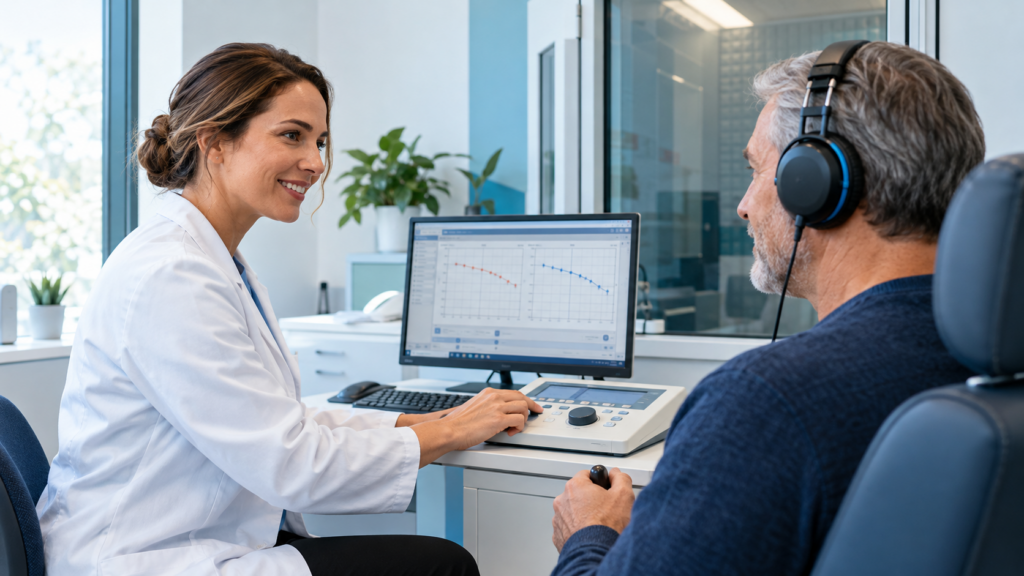
Audiology is rapidly moving beyond the traditional model of testing hearing in a quiet booth and fitting a device. Smart hearing aids, cochlear implants, artificial intelligence, spatial audio, remote programming, auditory training and immersive environments are creating new ways to assess and rehabilitate hearing in situations that are closer to everyday life.
A person does not simply need to hear that a sound exists.
They may need to identify it, understand speech, determine where it comes from, separate speech from noise, follow a conversation, orient toward an event and respond safely to the environment.
This leads to an important principle: Hearing rehabilitation is not only about audibility. It is about functional listening and participation.
What is audiology?
Audiology is a healthcare discipline concerned with hearing, auditory processing, balance and related communication needs.
Depending on professional scope and country, audiologists may work in hearing assessment, hearing-aid fitting, cochlear implant services, auditory rehabilitation, tinnitus management, vestibular assessment, pediatric hearing care, hearing conservation, assistive listening technologies and tele-audiology.
People receiving audiological care may include children with congenital hearing loss, adults with acquired hearing loss, older adults, cochlear implant users, people with single-sided deafness, people with auditory processing difficulties, individuals experiencing tinnitus and people with complex sensory or neurological conditions.
Hearing in the clinic is not the same as hearing in everyday life
Traditional audiological testing is highly controlled and may use pure tones, speech, headphones, standardized sound levels and quiet environments.
These procedures are essential.
But everyday listening is much more complex.
Real environments contain several speakers, background noise, reverberation, competing sounds, moving sound sources, unexpected events, visual information and social demands.
Someone may perform reasonably well during a clinical speech test but still struggle badly in restaurants, classrooms, meetings, transport or family gatherings.
Digital technology creates opportunities to complement traditional testing with more realistic listening tasks.
Eight technologies transforming audiology
1. Smart digital hearing aids
Modern hearing aids are sophisticated digital systems.
Depending on the device, they may use algorithms for amplification, noise reduction, directionality, feedback management, environment classification, speech enhancement and connectivity.
Some systems increasingly incorporate forms of machine learning or AI to help classify listening environments and modify processing.
The objective is not simply to amplify everything.
In a restaurant, amplifying speech, dishes, chairs and background conversations equally would not necessarily improve communication.
The goal is to improve access to relevant auditory information while maintaining useful environmental awareness.
2. Cochlear implants and digital programming
Cochlear implants can provide auditory information to people with severe-to-profound hearing loss when clinically indicated.
The rehabilitation pathway may include medical assessment, implantation, activation, device programming, auditory training, communication rehabilitation and long-term follow-up.
Technology is increasingly affecting not only the implant itself but also how it is programmed and monitored.
Remote programming is an important example.
But fitting the device is only the beginning. The brain still needs to learn how to interpret the auditory information.
3. Auditory training
Auditory training can help a person practice sound detection, sound discrimination, phoneme recognition, word recognition, speech understanding and speech-in-noise perception.
Digital platforms can make auditory training available between appointments.
But improvement in an application should eventually translate into better communication outside the application.
4. Spatial audio and 3D sound
One of the most important aspects of hearing is localization.
We constantly use auditory information to estimate whether a sound is on the left or right, in front or behind, close or far away, and whether it is moving.
Spatial hearing contributes to communication, environmental awareness, navigation and safety.
Three-dimensional audio systems can reproduce sound from different positions around the user.
A patient may hear sounds appearing behind them, to the side, above or below, and at different distances.
The therapist can ask the person to turn toward the sound, identify its location, distinguish two sound sources, follow a moving source or detect a target within background noise.
This creates a type of auditory spatial rehabilitation that is difficult to reproduce repeatedly with conventional speakers in a small clinical room.
5. Virtual reality for hearing rehabilitation
Virtual reality is often considered a visual technology.
But this is incomplete.
A VR headset can also provide a three-dimensional auditory environment.
The system can associate sounds with virtual people, vehicles, doors, objects, alarms and environmental events.
As the user turns their head, the sound field can change accordingly.
This means VR can create realistic listening situations that combine sound + space + movement + context.
A patient may practice identifying who is speaking, turning toward a speaker, following a conversation across several people, detecting environmental sounds, listening while moving and understanding speech in noise.
Why VR can add something that headphones alone cannot
A conventional auditory training application may present sounds.
VR can place those sounds inside a meaningful environment.
Instead of hearing a car sound from a left speaker, the patient may be standing virtually at a street crossing and need to identify where a vehicle is approaching from.
Instead of listening to isolated speech in noise, the user may be inside a café, classroom, meeting room, supermarket or train station.
This can help bring rehabilitation closer to the situations where hearing difficulties actually occur.
6. Tele-audiology
Tele-audiology can extend hearing care beyond specialized centers.
Services may include counselling, hearing-aid follow-up, device troubleshooting, selected assessments, rehabilitation and cochlear implant follow-up.
The strongest model may therefore be hybrid: in-person assessment → device fitting → remote support → home auditory training → periodic reassessment.
7. Mobile applications and connected hearing devices
Smartphones are becoming part of the hearing-care ecosystem.
Depending on the device and application, users may be able to adjust selected hearing-aid parameters, stream audio, monitor battery status, access remote support, complete listening exercises and record outcomes.
Connectivity can improve convenience and continuity.
But complexity can also become a barrier, particularly for users with limited digital literacy, visual difficulties, cognitive impairment or motor difficulties.
Accessibility must therefore remain part of device design.
8. Artificial intelligence in auditory rehabilitation
AI may increasingly support sound classification, speech enhancement, noise suppression, adaptive training, auditory-scene analysis and data interpretation.
Future training systems could potentially adjust difficulty according to performance.
For example, if a person consistently identifies speech correctly in quiet, the system might increase background noise, number of speakers, distance or reverberation.
But automated progression needs to remain clinically meaningful and transparent.
Hearing rehabilitation is increasingly multimodal
Communication rarely depends on hearing alone.
People naturally combine sound, lip reading, facial expressions, gestures, context and body orientation.
This makes immersive environments especially interesting.
VR can manipulate how much visual information is available.
For example, a therapist could compare audio only, audio + face, audio + lip movement, audio + gestures and several competing speakers.
This can help explore how a person uses multisensory information during communication.
Full immersion does not necessarily depend on vision
This is an important principle that is often misunderstood.
A virtual environment does not need to rely primarily on vision to create immersion.
For people with visual impairment or blindness, an immersive environment can be constructed using spatial audio, head orientation, body movement, vibration, haptic feedback and tactile interaction.
The environment can therefore communicate through whichever sensory channels are available to the person.
For someone with reduced vision, sound can provide information about direction, distance, movement and environmental structure.
This transforms VR from a purely visual medium into a multisensory spatial interface.
For audiology, this is relevant because hearing itself can become the primary navigation and interaction channel.
Using sound to train orientation
A simple immersive exercise might begin with one sound, one direction and minimal background noise.
The patient turns toward the sound.
Difficulty can then increase through several possible directions, varying distances, moving sound sources, competing sounds and complex environments.
The therapist may observe localization accuracy, head-turning behaviour, reaction time, confidence and search strategy.
These measures should not automatically be considered diagnostic metrics, but they can provide useful information during training.
Haptics and vibration as an additional sensory channel
Auditory information can also be combined with vibration.
Different patterns of vibration may potentially signal confirmation, direction, proximity, warning or environmental events.
For example, vibration on one controller could indicate an object on that side, increasing vibration intensity could signal proximity, and different patterns could represent different categories.
This creates possibilities for multisensory rehabilitation where sound and haptics work together.
Remotion: exploring spatial orientation and multisensory interaction
This principle is relevant to work explored at Remotion around immersive accessibility.
Remotion has explored concepts involving spatial orientation, immersive environmental exploration, non-visual feedback and haptic or vibration-based differentiation of virtual information.
One concept involves using different vibration patterns to help a user differentiate or recognize virtual shapes, directions or environmental information.
Another involves spatial orientation tasks where the user interprets information from the surrounding immersive environment rather than simply looking at a screen.
These concepts should currently be understood as exploratory rehabilitation approaches, not as established clinical diagnostic tools.
The broader idea is nevertheless important: the virtual environment can be adapted to the person’s sensory abilities rather than requiring the person to adapt to a visually dominated environment.
This inclusive immersive approach is consistent with Remotion’s broader exploration of accessible AR/VR applications, including accessibility-focused discussions and concepts developed in the Qatar/Mada innovation context.
Three realistic clinical scenarios
New hearing-aid user
A patient receives hearing aids but reports difficulty understanding conversations in restaurants.
The audiologist may combine device adjustment, counselling, speech-in-noise training and immersive listening practice.
A virtual restaurant could progressively introduce background voices, music, moving speakers and different seating positions.
The goal is not simply to improve the score. It is to help the person participate more confidently in real social situations.
Cochlear implant rehabilitation
A cochlear implant recipient may initially practice detection, discrimination and word recognition.
Later, digital training can progress toward speech in noise, localization, multiple speakers and functional environments.
The challenge gradually moves from Can I hear it? to Can I understand and use this information in everyday life?
Spatial orientation training
A person with reduced visual input may use an immersive environment where sound is the main source of spatial information.
The system presents auditory targets around the person.
The person needs to identify the direction, turn toward it, move toward the source and distinguish several sources.
Haptic feedback may provide additional information.
The objective is to work on spatial strategies in a controlled environment before transferring them to real situations.
From auditory metrics to communication
| Digital metric | Possible meaning | Important limitation |
|---|---|---|
| Detection accuracy | Awareness of sound | Does not equal understanding |
| Word recognition | Speech perception | Often easier than real conversation |
| Speech-in-noise score | Complex listening | Depends strongly on test conditions |
| Localization error | Spatial hearing | Real environments are more complex |
| Reaction time | Auditory processing | Influenced by motor response |
| Training repetitions | Practice dose | Does not equal learning |
| Hearing-aid usage time | Device use | Does not prove communication benefit |
| App engagement | Participation in training | Use does not equal outcome |
| VR task accuracy | Functional listening practice | Must transfer to real life |
The progression should remain: sound detection → understanding → spatial use → communication → participation.
Listening effort matters
A person may understand the words correctly but require enormous effort to do so.
Listening effort can contribute to fatigue, withdrawal from conversation, reduced concentration and avoidance of social environments.
Digital rehabilitation should therefore avoid focusing only on percentage-correct scores.
Hearing devices should adapt to the person—not the reverse
Smart devices increasingly adapt automatically.
But personalization should remain guided by the person’s needs.
Two users with similar audiograms may have very different priorities.
One may prioritize conversation at work. Another may prioritize music, outdoor awareness, family communication or safety.
Technology should support these functional priorities.
What does the evidence tell us?
Digital audiology includes several distinct interventions.
Tele-audiology, online auditory rehabilitation, VR, AR, hearing-aid algorithms and cochlear implant programming have different evidence bases.
The appropriate progression is: technical performance → auditory validity → functional listening → communication → participation.
Ten questions before adopting digital hearing technology
- What listening problem are we trying to solve?
- Is the technology validated for the intended use?
- Does it improve hearing or simply generate more data?
- Can the user operate it independently?
- Does training include realistic listening conditions?
- Can difficulty be personalized?
- Does performance transfer outside the application?
- Is the technology accessible when other sensory or cognitive impairments are present?
- Does remote care maintain sufficient professional support?
- Does the intervention improve meaningful communication?
The future of audiology: from hearing devices to adaptive listening environments
The future of hearing rehabilitation may extend beyond fitting a device.
Audiologists may increasingly work with connected hearing aids, cochlear implants, AI-assisted signal processing, remote programming, home training, spatial audio, VR environments and multisensory feedback.
A hearing device processes sound.
An immersive rehabilitation environment can teach the person how to use auditory information in context.
At Remotion, this perspective opens particularly interesting possibilities.
A virtual environment can create directional sounds, moving sources, multiple speakers, environmental alarms, speech in noise, auditory navigation and multisensory cues.
The therapist can control the complexity of the environment and gradually increase the demands.
And importantly, immersion does not have to be visual.
Sound, movement and haptic feedback can themselves construct the therapeutic environment.
The future is therefore not only about smarter hearing devices.
It is about creating smarter listening experiences that connect hearing with orientation, communication and participation.
Frequently asked questions
Can VR be used for hearing rehabilitation?
Potentially, yes. VR can create controlled three-dimensional listening situations involving localization, speech in noise, multiple speakers and environmental sounds.
What is spatial audio?
Spatial audio creates the perception that sounds originate from different locations around the listener rather than from a single left or right channel.
Can VR help someone learn where sounds come from?
It can be used to create localization exercises and spatial auditory training. The clinical value depends on the patient, system and rehabilitation objective.
Can people with visual impairment use immersive VR?
Yes. An immersive environment does not need to depend primarily on vision. Spatial audio, body movement, vibration and haptic feedback can provide important environmental information.
Can hearing rehabilitation be done remotely?
Many components can be supported remotely, including counselling, selected hearing-device follow-up and auditory rehabilitation. Suitability depends on the person and service model.
Can cochlear implants be programmed remotely?
Remote programming is increasingly being studied and used in selected settings, with recent evidence supporting its feasibility for appropriate patients.
Can AI automatically optimize hearing aids?
AI and machine-learning techniques can assist environmental classification and signal processing, but personalization, reliability and user preferences remain important.
Is better speech recognition enough?
No. The ultimate goal is functional communication and participation in meaningful listening environments.
Selected references and further reading
- Shah AH et al. Speech Perception Outcomes in Cochlear Implant Users Undergoing Remote Versus In-Person Programming: A Systematic Review and Meta Analysis. 2025.
- Effect of selected components of aural rehabilitation delivered in-person versus guided internet-based modalities on quality of life in adults with hearing loss: a systematic review and meta-analyses. 2026.
- Efficacy of Self-Directed Auditory Rehabilitation in Individuals With Hearing Loss: A Systematic Review and Meta-Analysis. 2026.
- Systematic Review of Auditory Training Outcomes in Adult Cochlear Implant Recipients and Meta-Analysis of Outcomes. 2024.
- Applications of Augmented and Virtual Reality in Enhancing Communication for Individuals Who Are Hard of Hearing: A Systematic Review. 2024.
- Kirk KR et al. The potential of teleaudiology in remote areas as the Arctic: a scoping review of treatment and rehabilitation in remote and low-resource settings. 2025.
- Restoring Sound Localization in Single-Sided Deafness Through Cochlear Implantation: A Meta-Analysis. 2026.
- Sasu JK et al. Ethics surrounding artificial intelligence-powered assistive technologies used by people with visual and hearing impairments: a systematic review. 2025.