

Introduction
Rehabilitation happens within everyday life, not only during appointments. For families managing school, work, transportation, caregiving and medical visits, telerehabilitation can make selected forms of support more accessible. Video consultations, asynchronous home activities, digital communication and therapist-guided remote monitoring may help connect clinical goals to real routines. However, remote care is not suitable for every person, task or clinical situation. Its value depends on professional judgment, consent, access, safety and meaningful outcomes.
What telerehabilitation means for families
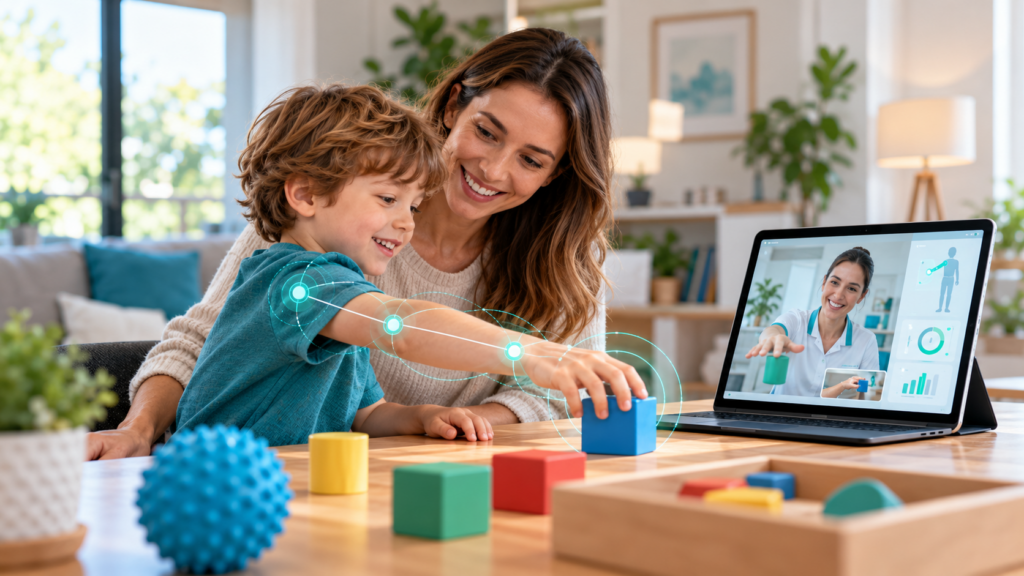
Telerehabilitation is the delivery of rehabilitation-related services at a distance using information and communication technologies. It may include live video appointments, review of an activity recorded with consent, secure exchange of instructions, remote coaching, accessible educational resources and structured home practice. Some programmes are entirely remote; others combine in-person and remote sessions.
Remote does not mean unsupervised. A qualified professional remains responsible for determining which tasks are appropriate, what support is needed, how progress is reviewed and when a physical assessment is necessary. A family caregiver may help position a device, prepare materials or report observations, but should not be expected to perform clinical procedures outside their role.
When remote rehabilitation can be helpful
Possible benefits include reducing some travel requirements, observing function in the actual home environment, involving family members who cannot attend in person and supporting continuity between appointments. A clinician may see how a person approaches their own kitchen, desk, bathroom routine or communication system rather than relying only on performance in a clinic.
Benefits are not guaranteed: remote services can introduce technical barriers, unequal access, privacy concerns and less reliable observation of certain physical signs. They should be selected when the advantages outweigh these limitations for the specific person.
The different formats
Live video sessions
The clinician and patient connect at the same time. This can support demonstration, coaching, discussion and selected assessment tasks, provided camera placement and safety allow adequate observation.
Asynchronous activities
The professional selects or prepares instructions, and the person works on agreed activities at another time. Progress is reviewed later. Clear dosage, stopping rules and communication arrangements are essential.
Hybrid rehabilitation
In-person assessment and periodic physical sessions are combined with remote follow-up, education or selected practice. For many people, a hybrid pathway is more realistic than an exclusively online service.
Family education and coaching
Therapists may teach caregivers how to simplify a routine, provide appropriate prompts or adapt a task without transferring professional responsibilities to them.
Preparing for the first session
- Confirm the clinical plan: Ask which activities will take place, who should be present and what equipment is required.
- Prepare a suitable space: Check lighting, noise, stable furniture, accessible materials and enough room for the planned activity.
- Test connectivity: Check the camera, microphone, audio, device battery and a fallback contact method.
- Consider accessibility: Arrange captions, language interpretation, alternative communication, accessible controls or a second screen where needed.
- Clarify safety: Know which activities are prohibited, when to stop and whom to contact if symptoms occur.
- Discuss privacy: Agree who will attend, whether any recording is necessary and which secure platform the service uses.
- Set one meaningful goal: Choose a daily activity that matters to the person rather than focusing only on an app score.
During a session: support without taking over
A caregiver may help the person connect, position the camera, arrange materials and communicate questions. During practice, allow the person to attempt the agreed task with the recommended level of assistance. Do not add hands-on support, balance challenges, transfers or resistance exercises unless specifically instructed and trained by the professional.
If the camera angle prevents safe observation, the task should be repositioned or deferred. A therapist may need to see the whole body for mobility tasks or the hands and working surface for fine-motor tasks. The family should feel comfortable saying when an activity is impractical, uncomfortable or unsafe.
What activities may be suitable?
Occupational therapy: routines, activities of daily living, environmental adaptations, executive-function supports and assistive-technology follow-up.
Physiotherapy: selected exercise coaching, mobility education and follow-up when the level of risk and supervision are appropriate.
Speech-language therapy: communication strategies, supported interaction, AAC coaching and selected language activities.
Psychology and psychomotor therapy: carefully selected interventions, education and participation-related activities, depending on professional scope and suitability.
The clinician must determine whether physical examination, manual assessment, specialized equipment or in-person observation is necessary. Remote care should never be presented as interchangeable with every aspect of hands-on rehabilitation.
Children and family-centred telerehabilitation
For children, remote sessions should reflect developmental level, communication abilities, attention, sensory preferences and family routines. A parent can help introduce an activity, but the therapeutic goal should not be to make the parent run a full clinic at home.
A child may benefit more from a short, motivating task followed by therapist coaching than from a prolonged video session. For a child with developmental coordination disorder, the focus might be schoolbag organization or dressing. For a child using AAC, the therapist may coach family members to model communication in natural activities. The child’s assent and comfort matter alongside the guardian’s consent.
Adults, older people and complex care
Remote follow-up may support meaningful activities after neurological injury, chronic conditions or during aging. Yet fall risk, cognitive impairment, vision difficulties, fatigue, unstable symptoms and caregiver availability influence suitability. A telephone consultation may be more accessible than video for some people; for others, a physical visit is essential. Plans should preserve the person’s autonomy and confidentiality even when family members assist.
Technology: from simple tools to immersive rehabilitation
Telerehabilitation does not require virtual reality. A phone call, video meeting, secure message, picture schedule or accessible checklist may be enough. Interactive games and movement tracking can supplement selected programmes, but their metrics require interpretation. Apparent improvement in a digital task does not automatically establish functional improvement outside the application.
Platforms such as Remotion explore interactive therapist-centred rehabilitation across different devices, with tools that can support flexible activities and professional follow-up. Remotion TheraVerse also explores configurable virtual environments for therapist-directed scenarios. Whether such systems belong in a home pathway depends on device access, supervision, clinical objectives, safety and the exact functionality available. Technology should complement, not replace, the therapeutic relationship.
Privacy and digital inclusion
A remote session may reveal private details of the home and other household members. Use the healthcare service’s approved communication channel, discuss consent before recording and avoid forwarding patient videos through insecure accounts. Children’s data and identifying health information warrant particular care. Do not upload identifiable clinical records to general-purpose AI systems without an appropriate lawful and professional framework.
Not every household has stable internet, a modern device, private space or digital literacy. Clinicians should consider telephone options, accessible materials, loan devices, interpretation, print resources and in-person alternatives. A family’s inability to use a platform must not be mistaken for unwillingness to participate.
When to stop or request in-person review
Pause the activity if the person experiences new pain, dizziness, marked fatigue, distress, unsafe balance, a change in ability or difficulty following instructions. Contact the care team according to the agreed plan. Severe or sudden symptoms—such as signs of stroke, chest pain, significant breathing difficulty or loss of consciousness—require local emergency services rather than continuing a digital session.
A face-to-face reassessment is needed when remote observation is insufficient, clinical risk increases or progress does not match expectations. The modality should adapt to the person, not the other way around.
How to evaluate outcomes
Before starting, agree on a baseline and a small number of goals tied to activities: completing more dressing steps independently, communicating a preference, preparing a simple meal, managing a school routine or joining a community activity. Track the assistance needed, comfort, confidence and sustainability. Session attendance, app scores and number of video calls describe service use, but do not by themselves demonstrate meaningful benefit.
Three examples of hybrid family care
Child developing morning independence
An occupational therapist assesses the family routine, demonstrates a visual sequence and agrees on prompts. The family tries the plan between sessions, then describes what worked. An in-person review is arranged if motor or sensory issues require closer assessment.
Adult after stroke returning to daily activities
After an in-person safety assessment, the rehabilitation team provides selected home tasks and remote follow-up. The caregiver assists with equipment setup but does not independently change exercise difficulty or perform physical transfers.
Older adult maintaining participation
A physiotherapist or occupational therapist reviews barriers to visiting friends and managing household activities. The team combines face-to-face assessment with phone or video check-ins, according to mobility risk and technology access.
These scenarios are illustrative rather than individual medical prescriptions.
Frequently asked questions
Can telerehabilitation replace in-person therapy?
Sometimes selected components can be delivered remotely, but many situations still require examination, equipment or supervision in person. A hybrid approach may be preferable.
Does a parent have to stay throughout a child’s session?
It depends on the child’s age, needs, the activity and the professional’s safety plan. The caregiver’s role should be agreed in advance.
Do we need expensive hardware?
Usually not for basic remote consultations and education. Devices should be chosen for a clear clinical purpose and accessible alternatives offered.
May families record the session?
Only within the provider’s consent and privacy rules. Ask before recording or sharing health information.
How can we tell if remote rehabilitation is working?
Measure participation, independence, comfort and meaningful function in daily life, not solely digital engagement.
Conclusion
Good telerehabilitation starts with a shared goal, not a connection link. It can help families engage in rehabilitation within the activities that matter to them, reduce certain access barriers and maintain appropriate professional follow-up. It also requires clear limits, individual safety plans, privacy protections and the right to choose in-person or non-digital alternatives. Families should be partners in care—not unpaid substitutes for clinicians.
Continue reading: Digital Rehabilitation for Families and Caregivers, How Families Can Support Home Rehabilitation, and Technology in Occupational Therapy.
References and further reading
- World Health Organization. Rehabilitation.
- World Health Organization. Recommendations on Digital Interventions for Health System Strengthening (2019).
- World Health Organization. Assistive Technology.
- World Federation of Occupational Therapists. Resources and professional guidance — consult applicable local telehealth standards.