

مقدمة
Autism is a neurodevelopmental condition associated with differences in communication, social interaction, interests, sensory experiences and patterns of activity. Autistic people have diverse strengths, needs, identities and preferences. Rehabilitation and support should aim to increase autonomy, well-being, accessibility and participation—not to erase autistic traits or demand that someone appear non-autistic. Virtual reality (VR), accessible games, augmentative and alternative communication (AAC) and artificial intelligence (AI) may support selected goals when their use is collaborative, clinically justified and adapted to the individual.
Begin with individual goals and a neurodiversity-affirming approach
Before selecting a device, ask the autistic person what they want to change in everyday life. Goals may concern communicating choices, preparing for school, navigating transport, taking part in a preferred activity, managing an environment that is overwhelming or developing independent living skills. Involve families and caregivers when welcomed and appropriate, without overriding the person’s own voice. A child’s assent, distress and preferences matter alongside applicable guardian consent.
Avoid making forced eye contact, suppressing harmless self-regulation behaviours or increasing social conformity the default measure of success. Clinical priorities should be safety, communication access, meaningful participation and quality of life.
Clinical evidence: what research actually shows
NICE guidance for autistic children and young people recommends individualized, developmentally appropriate support and considers play-based social-communication strategies involving trained professionals and supportive adults. It also emphasizes environmental, sensory and communication factors when responding to distress (NICE CG170).
A 2025 systematic review of 14 studies reported encouraging results for some VR social-skills interventions, but differences in study quality, participants, methods and adverse effects limit generalization (JMIR, 2025). A later network meta-analysis including 11 randomized trials and 718 children reported very substantial heterogeneity and an evidence network too sparse for stable comparative estimates (2026 review). VR therefore remains a possible adjunct for selected aims, not an established universal autism treatment or a replacement for accessible, relationship-based support.
Communication, AAC and accessible interaction
Communication is broader than speech. People may use spoken language, gestures, signs, pictures, writing, communication devices or AAC systems. Speech-language therapists and relevant professionals can help select meaningful tools and train communication partners. Digital resources may support expressing needs, planning conversations or understanding routines, but must be personalized to the person’s language and access methods.
AI speech or text generation can assist with creating draft materials, but must not misrepresent the person’s intentions, replace informed consent or be treated as a validated communication assessment.
Sensory differences and environmental adaptation
Light, sound, touch, crowds, unpredictable changes and movement can be experienced very differently by autistic individuals. Digital tools should offer adjustable brightness, sound, contrast, motion, instructions and opportunities to pause. Therapists may work with families, schools or workplaces on practical environmental adaptations. A sensory-friendly application should be evaluated with the actual user rather than assumed beneficial because it includes calming visuals.
Vibration-based haptic feedback and multisensory environments can provide cues in supported devices, but they are not equivalent to tactile or proprioceptive clinical assessment and should not be marketed as proven Ayres Sensory Integration interventions without relevant evidence.
Daily living skills and occupational therapy
Occupational therapists can address dressing, food preparation, school organization, transitions, play, leisure and community participation. Visual schedules, interactive sequencing tasks and adjustable simulated environments may make practice more predictable or accessible. Transfer matters: successfully selecting objects in a virtual kitchen does not necessarily mean someone can prepare a meal independently in their own kitchen. Evaluate actual routines and adjust the environment, not simply game difficulty.
VR and simulated real-world situations
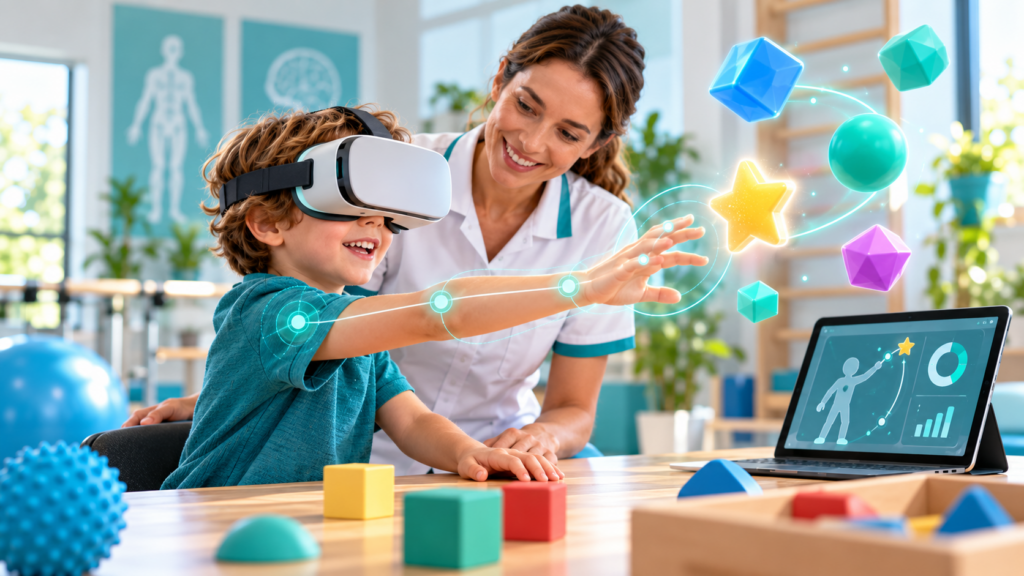
VR and screen-based simulations may provide a structured way to rehearse selected situations such as shopping, using public transport or navigating a social environment. Immersive headsets, however, can be uncomfortable or overwhelming and require attention to age guidance, device fit, cybersickness, visual sensitivities, balance and supervision. Non-immersive screens or real-world practice may be more appropriate. The user should be able to control the experience and stop it without penalty.
Simulations must not be treated as a prerequisite for community participation. A person should not have to prove social conformity in VR to receive support.
Serious games, motivation and meaningful engagement
Games may allow preferred interests, clear feedback, adjustable pace and frequent opportunities to practise. Some people enjoy interactive practice; others find it distracting or aversive. Points, streaks or rapid stimulus changes are not always motivating. Choose activities with the person and monitor fatigue, frustration and actual functional gains. An increase in app usage is not, by itself, a clinically important outcome.
Remotion Classic and TheraVerse
Remotion Classic provides therapist-centred interactive rehabilitation activities on supported devices. Remotion TheraVerse supports a configurable virtual room where a clinician can position interactive objects and add visual, auditory and compatible vibration-based haptic cues. This design flexibility may help professionals develop scenarios for a person’s functional goals or sensory preferences. It does not establish autism-specific clinical efficacy, diagnostic validity or suitability for every child. Professionals must evaluate risk, preferences, accessibility and real-world outcomes before selecting an activity.
AI and therapist-designed personalization
AI and low-code development can help therapists prototype tailored visual schedules, interactive routines, accessible educational materials or simple tasks based on an individual’s interests. Clinical teams increasingly need AI literacy to inspect generated tools critically. A technically working prototype is not automatically clinically effective, privacy compliant or legally eligible for medical use.
Do not use general-purpose AI as an autonomous autism diagnostic tool or allow it to prescribe interventions without validation. AI-generated descriptions of emotion or intent may be unreliable, especially for people whose communication differs from the data used to train models. Minimize health-data sharing, review outputs and ensure human accountability.
Family-centred telehealth and interdisciplinary work
Remote sessions may help professionals observe everyday routines and coach caregivers with their agreement. Parents should not be expected to deliver therapy in place of clinicians. Occupational therapists, speech-language therapists, psychologists, physiotherapists, psychomotor therapists, educators and physicians may collaborate as appropriate to the person’s needs. A hybrid pathway can combine in-person assessment, remote education and home-context practice while respecting access, privacy and family workload.
Outcome measurement and safeguards
Focus on the person’s chosen outcomes: expressing choices, participating in a preferred activity, managing a transition with less distress or becoming more independent in a daily task. Suitable clinical and patient-reported measures may complement contextual observations. Record technology-generated scores as process data unless their clinical interpretation is validated. Avoid continuous recording, intrusive behavioural surveillance or using game scores to classify someone’s worth or potential.
Stop or change activities when the person expresses refusal, distress, discomfort or sensory overload. Escalate safety concerns or co-occurring medical symptoms through appropriate clinical channels.
Regulatory considerations: EU, United States and Middle East
European Union
The قانون حماية البيانات الشخصية governs personal data, with additional safeguards for health information and specific considerations for children. Software with a medical intended purpose may qualify under MDR 2017/745. The EU AI Act may also be relevant depending on the system’s function and risk, subject to current implementation rules and amendments.
United States
The FDA assesses software according to intended medical purpose and applicable exclusions. HIPAA applies to covered entities and business associates in specified circumstances, not every consumer app. Where applicable, COPPA and other privacy rules can affect online services directed to children.
Middle East
Requirements vary by country. In Saudi Arabia, examine SFDA digital-health/medical-device rules and personal-data obligations. In the United Arab Emirates, consider applicable medical-device authorization, health-information legislation including Federal Law No. 2 of 2019, and relevant privacy requirements. In Qatar, assess Personal Data Privacy Protection Law No. 13 of 2016 and applicable healthcare authority requirements. Particular attention is needed for children’s data, recordings, cloud hosting, cross-border transfers and professional practice.
An educational game, a communication aid and diagnostic or treatment-recommending software can face different regulatory requirements. The assessment depends on intended purpose, functions, claims and market. This overview is informational, not legal advice.
Illustrative scenarios
Morning routine and autonomy
An autistic child and family choose a more predictable school-preparation routine. An occupational therapist helps tailor visual instructions and environmental changes. Success is measured through reduced difficulty and increased participation in the real routine, not by a digital score alone.
Communicating preferences
An autistic adolescent uses preferred AAC tools to express interests and boundaries. A speech-language therapist supports the chosen communication mode; the goal is greater communicative agency, not enforcing typical speech patterns.
مشاركة المجتمع
An adult wants to visit a shop with less uncertainty. A clinician and the person explore a structured rehearsal or visual plan, followed by an accessible real-world strategy. The person decides whether simulation is helpful.
These examples illustrate person-centred design and do not prescribe individual interventions.
الأسئلة الشائعة
Can VR cure autism?
No. Autism is not something that digital rehabilitation cures. Technologies may support selected functional goals and participation.
Are digital games appropriate for all autistic children?
No. Preferences, sensory needs, development, access and safety vary. Offer alternatives.
Can AI reliably read an autistic person’s emotions?
Do not assume so. Such inferences can be inaccurate and should not replace asking the person or interpreting communication in context.
Can families use activities without therapist guidance?
General educational resources may be useful, but medical or safety-sensitive interventions require appropriate professional advice.
What is the best outcome to measure?
Choose a meaningful activity, autonomy or participation goal defined with the individual, then use suitable measures and review it together.
Conclusion and sources
Digital tools can help autistic people and clinicians create more accessible opportunities for communication, independence and participation, provided they are chosen with—not imposed on—the person. VR, serious games, AAC and AI should support neurodiversity-affirming, evidence-informed and accountable practice.
Related reading: Technology for Children With Developmental Disabilities; Using VR Safely With Children; Remote Rehabilitation for Children and Families.