

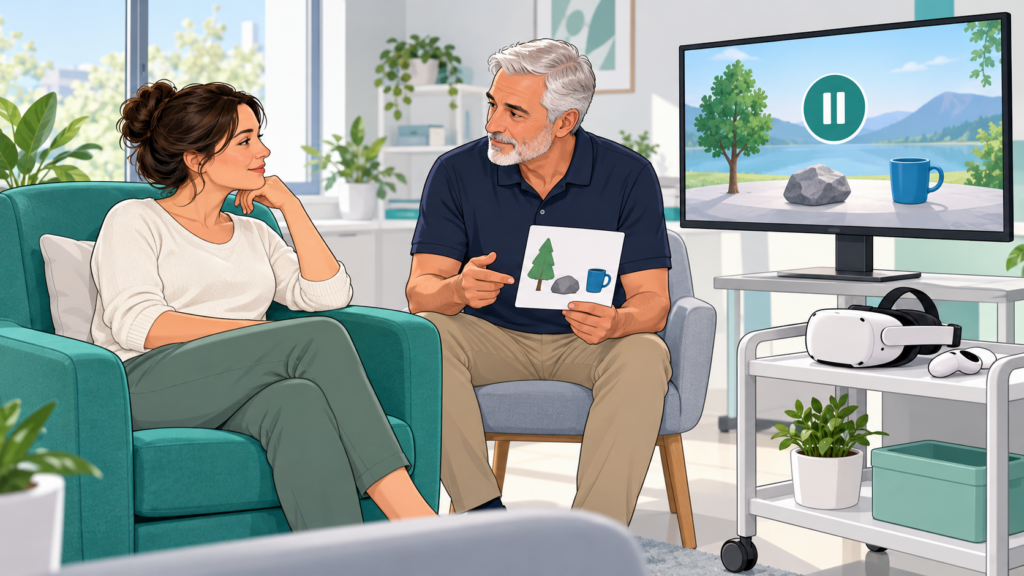
An immersive activity asks the person to do more than the exercise displayed. They also need to understand instructions, interpret a scene, manage an input and communicate with the therapist while wearing equipment. These demands deserve attention when planning rehabilitation.
A slower answer or more errors do not identify fatigue or cognitive overload on their own. Access difficulty, unfamiliar controls, discomfort or a change in the task may produce similar observations. The therapist needs to ask, observe and compare the situation with the person’s usual presentation.
Separate the goal from avoidable difficulty
State the intended demand: choosing an object, remembering a rule or practising a movement. Then identify requirements that are not part of that goal. Learning an unfamiliar controller or searching a decorative, crowded scene may add effort without serving the task.
Explain the activity in an accessible way and try the response method before adding complexity. A person who understands the task may still struggle with the interface. Simplifying access is different from making a clinical conclusion about attention or memory.
Ask about the whole day
Discuss how the person feels before starting, the effort of reaching the session and what they need to do afterwards. Ask about fatigue and comfort during the activity and after removing the headset. Enthusiasm is useful feedback, but it does not reveal the entire cost of participation.
NICE’s stroke guidance includes fatigue assessment and tailoring rehabilitation to individual needs. [1] That is condition-specific guidance, not a universal headset duration. No fixed number of minutes or repetitions in this article is prescribed for all users.
Observe changes without labelling them too quickly
Examples worth exploring include repeated requests for instructions, unplanned inputs, a change in strategy, reduced interaction or a request to pause. Ask what the person is experiencing. Do not assume that these behaviours mean reduced motivation or a cognitive deficit.
Distinguish tiredness from symptoms such as nausea, dizziness or visual discomfort. Their meaning and response depend on the clinical situation. Stop or pause when needed and seek appropriate assessment for concerning, new or worsening symptoms. Completing the activity is not more important than responding to the person.
Change one demand and review the response
Where the software allows, consider fewer choices, a quieter scene, clearer prompts or less time pressure. Check whether the change preserves the goal. Removing a memory rule, for example, changes a memory task; record that rather than comparing the scores as though conditions were identical.
Agree on a usable stop method before starting. A pause may involve removing the headset with appropriate support and reviewing the task in a quieter setting. The next decision can be to resume, simplify, switch medium or end the activity. Continuing is not the default outcome of every pause.
An illustrative planning grid
This original example is for a qualified clinician and an adult assessed as suitable for supervised VR. It is not a validated fatigue-management programme.
| Element | Illustrative approach |
|---|---|
| Objective | Make a purposeful choice relevant to an everyday activity. |
| Context | Individual supervised session with communication and access checked. |
| Task | Choose among a small number of virtual objects using one clear rule. |
| Configuration | Adjust choices, scene detail, timing and input where available. |
| Observations | Errors, help, comfort, strategy, requests to repeat and the person’s account of effort. |
| Simplification | Reduce an unnecessary demand while documenting what changed. |
| Progression | Change one relevant demand when appropriate, then reassess tolerance. |
| Cautions | Respond to symptoms or a request to stop; avoid pressure to complete a target count. |
| Documentation | Record conditions, pauses, assistance, perceived effort and the next decision. |
Interpret performance with its conditions visible
A lower score after a longer or more complex task does not establish deterioration. An improved score after extensive prompting does not demonstrate independence. Keep software events separate from clinical observations and the person’s reported experience.
Compare like conditions where that is the purpose, and make differences explicit. Use appropriate validated assessments when the clinical question concerns fatigue or cognition. A game score cannot replace them simply because it is numerical.
VR is one possible delivery medium. A well-timed pause, a shorter task or a screen-based alternative can protect the purpose of a session. The aim is useful participation within the wider rehabilitation plan, not endurance inside a headset.
Discuss your intended activities with the Remotion team through the website contact page. Confirm the adjustments available in the actual configuration before planning a session.
References
- NICE. Stroke rehabilitation in adults. NG236. Fatigue and individualised rehabilitation recommendations. https://www.nice.org.uk/guidance/ng236/chapter/Recommendations . Checked 25 October 2026. Stroke-specific reference, not general VR dose or a validated cognitive-overload rule.