

Introduction
Parkinson’s disease affects movement and can also influence cognition, communication, mood, sleep and participation. Rehabilitation complements medical management by helping people maintain safe mobility, meaningful daily activities and quality of life. Virtual reality (VR), interactive exercises, wearables, cueing systems and artificial intelligence (AI) may add useful tools, but each application should be judged by clinical evidence, usability and the individual’s goals.
Clinical rehabilitation priorities
Rehabilitation plans should consider bradykinesia, rigidity, tremor, balance difficulties, freezing of gait, reduced arm swing, fatigue and non-motor symptoms, while recognizing that presentations differ widely. Functional priorities may include walking to a local shop, rising from a chair, dressing, handwriting, preparing meals and social participation. Medication timing, symptom fluctuation, falls history, cognitive status, orthostatic symptoms and support at home may affect assessment and treatment choices. Decisions belong to the treating interdisciplinary team.
What the evidence supports
The American Physical Therapy Association clinical practice guideline (2022) provides strong recommendations for appropriately prescribed aerobic exercise, resistance training, balance training, gait training, external cueing and task-specific training. These recommendations concern clinical interventions, not a particular device. A Cochrane review of virtual reality (2016) included eight trials with 263 participants and reported low- or very-low-certainty evidence; some gait parameters may improve, while broad superiority over physiotherapy could not be established. Later studies exist, but results still need to be assessed by intervention and outcome rather than generalized to every VR product.
Gait, freezing and external cueing
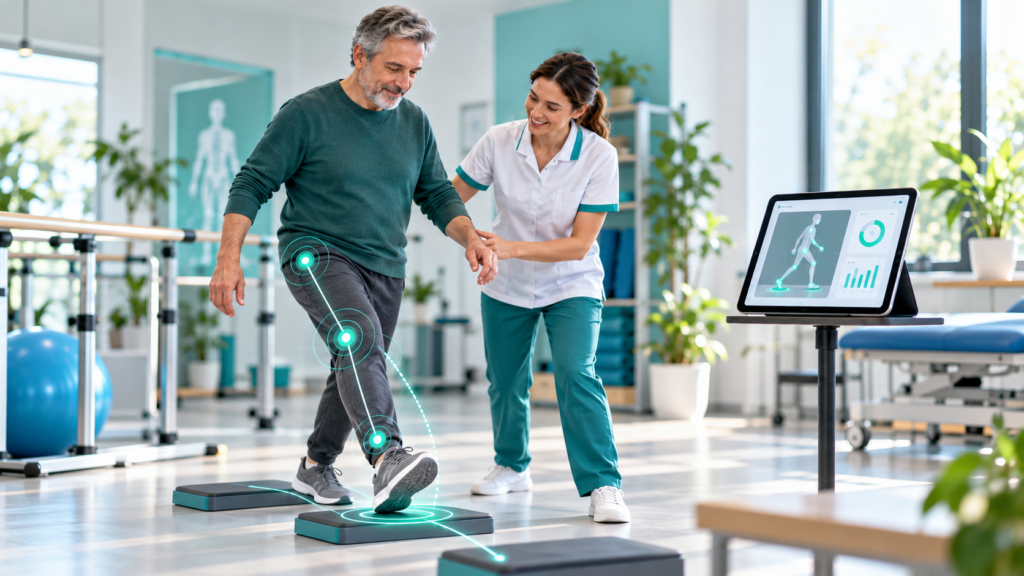
Auditory rhythms, visual markers and other appropriately selected cues can support gait training for some people. Wearables and interactive environments may offer feedback about stepping, timing or movement initiation. Yet a visual cue on a screen is not automatically equivalent to safe walking in a busy environment. Clinicians should evaluate cue dependence, dual-task challenges, fall risk, turning, fatigue and real-world transfer. Freezing episodes and balance disturbances often require direct assessment and supervision.
Balance, strength and transfers
Structured resistance, balance and task-specific training are important components of physiotherapy. Remote or game-based tasks may complement a supervised plan, but standing challenges, rapid turns and transfers can carry substantial fall risk. Progression should reflect clinical assessment rather than automatic difficulty increases after a high game score. An accessible seated alternative may be more appropriate for some people.
Upper-limb function, hand use and daily activities
Parkinson’s disease may affect dexterity, movement initiation, speed and coordination. Occupational therapists can address meaningful occupations such as buttoning clothes, handling utensils, writing or preparing food. Interactive reaching, timing and manipulation activities can provide selected practice opportunities. Digital performance measures should be interpreted cautiously: better speed or accuracy in a game does not prove easier self-care without observation in everyday contexts.
Cognition, communication and participation
Executive functioning, attention, mood and communication differences may influence therapy engagement. Speech-language therapists can address communication and swallowing-related concerns within their professional scope; neuropsychologists and other team members can contribute cognitive and psychosocial assessment. Digital cognitive activities should be linked to authentic goals such as organizing a routine or participating in conversations. A chatbot or game must not replace formal cognitive or speech assessment.
Motion tracking, sensors and digital measures
Wearables, cameras and controllers can capture selected signals such as steps, movement timing, repetitions, movement amplitude or task accuracy. Measurement error may arise from device placement, occlusion, calibration, algorithm performance or symptom fluctuation. Results may differ during medication ON/OFF periods. A sensor value is not automatically a validated biomarker of Parkinson’s progression. Before using a metric for clinical decisions, establish its reliability, validity, intended interpretation and practical limitations.
Virtual reality and serious games
Screen-based serious games, immersive VR and mixed-reality experiences differ in physical and cognitive demands. Immersive systems require assessment of balance, dizziness, visual comfort, device fit, fatigue and supervision. Patients should be able to pause or use a less immersive alternative. More repetition can be useful for a selected task, but engagement and scores are not substitutes for meaningful functional gains. VR remains an adjunct chosen for a specific clinical purpose, not a universal first-line therapy.
Remotion in a therapist-led pathway
Remotion Classic provides therapist-centred interactive rehabilitation activities across compatible devices. Remotion TheraVerse supports therapist-configurable virtual rooms with interactive objects and visual, auditory and compatible vibration-based haptic cues. Clinicians may use configurable activities to explore appropriate movement or task practice, but product flexibility alone does not demonstrate Parkinson’s-specific treatment efficacy, clinical validation of tracking metrics, or suitability for unsupervised home use. Selection and progression remain professional responsibilities.
AI and personalized rehabilitation
AI may help clinicians prepare understandable instructions, draft educational materials, organize appropriately protected observations or prototype personalized games using low-code development. Therapists increasingly need AI literacy to assess digital tools and co-design interventions aligned with patients’ needs. However, an AI-generated activity is not necessarily clinically validated or regulated appropriately. AI can hallucinate, introduce bias or misread changes in motor performance. Never allow an unvalidated system to independently change exercise dose, diagnose deterioration or recommend medication changes. Identifiable health data require approved safeguards.
Telerehabilitation and hybrid follow-up
Hybrid care can combine in-person neurological and functional assessment with selected remote coaching, education or home practice. The appropriate mix depends on falls risk, symptom variability, communication needs, equipment and access. Video observation cannot replace hands-on examination when needed. Plans should document stop criteria, technical-failure procedures, caregiver responsibilities and when in-person reassessment is required.
Outcome measurement
Select patient-defined goals and suitable standardized assessments, supported by patient-reported outcomes and selective digital metrics. Depending on clinical purpose and training, clinicians may use established measures of mobility, balance, motor symptoms, activity performance and quality of life. Document medication state and assessment conditions where relevant. Observe whether gains carry into real tasks—such as safer walking to a café, independent dressing or more confident social participation—rather than equating game scores with recovery.
Safety considerations
Screen for falls, orthostatic symptoms, freezing, fatigue, cognitive or visual difficulties and physical environment. Some tasks require direct guarding and cannot be prescribed as unsupervised remote exercises. New severe symptoms, collapse, chest pain or sudden neurological changes warrant urgent medical evaluation. Device discomfort, cybersickness or unsafe movement should prompt stopping and clinician review. This guide does not provide individual exercise prescriptions.
International regulatory overview
European Union
The GDPR governs personal and health-data processing. Software intended for a medical purpose may fall under MDR 2017/745; qualification depends on claims, intended use and function. The EU AI Act may impose further obligations, and applicable dates should be verified against current guidance.
United States
FDA oversight depends on intended medical use and applicable exclusions. HIPAA applies to covered entities and business associates in defined circumstances rather than all wellness applications; FTC and state laws may also be relevant. Cross-state telehealth practice requires separate professional review.
Middle East
Requirements are country-specific. Saudi Arabia has SFDA guidance on software as a medical device and data protection obligations; the UAE has applicable medical-product and health-data requirements including Federal Law No. 2 of 2019; Qatar has Personal Data Privacy Protection Law No. 13 of 2016 and relevant health authority requirements. Cloud storage, cross-border transfers, professional authorization and medical claims need local assessment.
An educational game, movement-monitoring software and AI recommending treatment may face different regulatory obligations. This overview is not legal advice.
Three illustrative scenarios
Walking to a nearby café
A person wants to resume a regular outing. A physiotherapist assesses gait, freezing and fall risk; selected cueing or interactive activities complement supervised walking practice. Progress is assessed in community participation.
Preparing breakfast independently
An occupational therapist targets utensil handling and sequencing through real-task adaptation and, if suitable, interactive exercises. The outcome is safe daily performance rather than software speed alone.
Home follow-up with fluctuating symptoms
The team uses occasional remote reviews between in-person appointments and records relevant contextual factors, including symptom variation and device limitations. New instability triggers in-person reassessment.
Examples illustrate reasoning, not patient-specific instructions.
Frequently asked questions
Can VR cure Parkinson’s disease?
No. VR may support selected rehabilitation activities but does not cure the disease.
Does a wearable diagnose disease progression?
Not automatically. Measurement and clinical interpretation require appropriate validation.
Are serious games better than physiotherapy?
There is no universal superiority. Suitability and evidence differ across tasks and populations.
Can AI prescribe medication or exercises autonomously?
Unvalidated AI should not make these clinical decisions.
Must a person use an immersive headset?
No. Non-immersive, conventional and in-person alternatives may be safer or more accessible.
Conclusion and references
Technology can enrich Parkinson’s rehabilitation when used as part of a clinically justified, patient-centred pathway. Evidence-based exercise, safe mobility, participation and interdisciplinary care remain central. VR, sensors and AI should help qualified professionals personalize practice and evaluate meaningful outcomes without overstating their evidence.
Related reading: Stroke Rehabilitation and Digital Technologies and Measuring Outcomes in Hybrid Rehabilitation.
- Osborne JA et al. Physical Therapist Management of Parkinson Disease: A Clinical Practice Guideline, 2022.
- Dockx K et al. Virtual reality for rehabilitation in Parkinson’s disease, Cochrane, 2016.
- WHO. Rehabilitation.