

Introduction
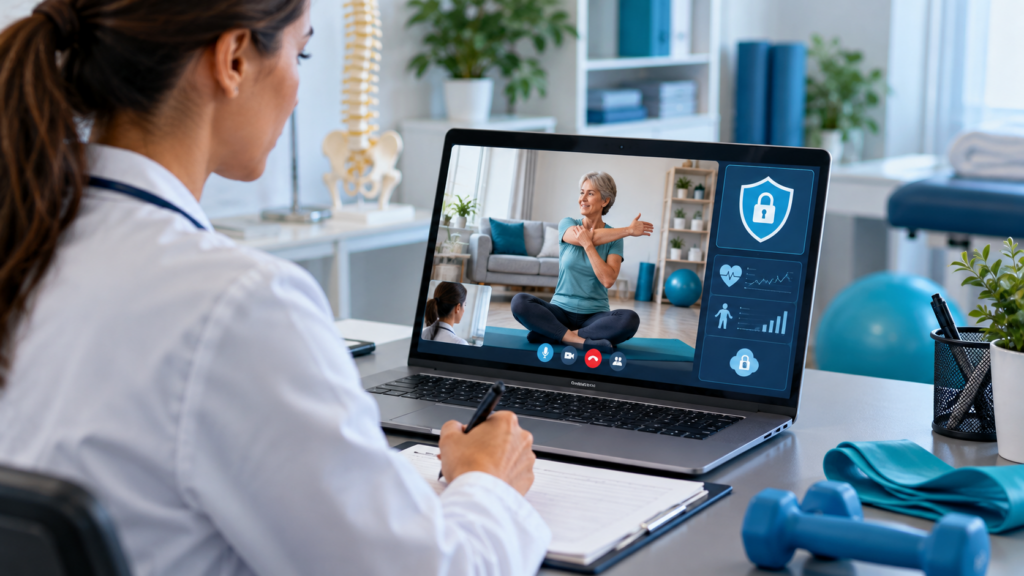
Telerehabilitation can improve continuity of care, but digital convenience does not eliminate clinical responsibility. Video visits, interactive exercises, remote measurements and AI services introduce risks that range from unauthorized data access to unsafe treatment decisions. A mature rehabilitation service should manage privacy, cybersecurity, clinical safety and professional accountability together. This guide presents a practical framework for therapists, healthcare organizations and digital health teams.
Understand the four risk domains
- Privacy: personal information is collected, used, shared or retained without an appropriate purpose, transparency or legal basis.
- Cybersecurity: accounts, devices, networks, software or cloud services are compromised, unavailable or altered.
- Clinical safety: misleading measurements, poor patient selection, unclear instructions or inappropriate escalation contribute to harm.
- Operational and equity risks: failures of connectivity, access, training, language or support interrupt care and exclude some patients.
These risks interact. For example, a compromised account may expose sensitive health information and allow an unauthorized person to modify a home exercise plan.
Map the data lifecycle before deploying software
Start by documenting which data are collected, why and by whom. A rehabilitation service might process identity and contact details, clinical notes, videos, audio, movement trajectories, game scores, sensor readings and caregiver messages. Some seemingly anonymous recordings or movement patterns can still identify a person, particularly when combined with other information. Map collection, storage, transmission, access, exports, retention, deletion, backups and subcontractors. Data minimization reduces both privacy exposure and breach impact.
Consent, transparency and lawful processing
Tell people what a service does in accessible language: whether a session is recorded, whether cloud processing occurs, who may review results, and what is shared with providers or AI systems. Clinical consent to participate in remote care is distinct from the legal basis for processing personal data. In the EU, explicit consent is not the only possible lawful condition for health-data processing, and consent must not be treated as a universal substitute for the GDPR’s requirements. Where children are involved, address guardian authority, the child’s evolving autonomy and applicable safeguards.
Cybersecurity controls that matter
- Identity and access: individual accounts, strong authentication, role-based permissions and prompt removal of access when roles change.
- Encryption: appropriate protection of data in transit and at rest, along with sound key management.
- Device and software hygiene: supported operating systems, timely patches, secure configuration and controlled updates.
- Logging and auditing: monitor relevant access and changes without unnecessarily exposing sensitive details in logs.
- Resilience: backups, recovery testing, incident-response plans and clinically safe downtime procedures.
- Supplier assurance: assess hosting, subprocessors, security practices, vulnerability management and contract responsibilities.
No single certification or hosting claim guarantees security. Controls need to be proportionate to risk and tested in actual use.
Clinical hazards specific to remote rehabilitation
A therapist cannot always inspect a patient’s environment or physical status fully through a camera. Falls, unstable symptoms, unsafe transfers, excessive exercise load, device discomfort and misunderstanding of instructions may go unnoticed. Pose estimation and wearable data can be distorted by camera position, calibration, occlusion or sensor drift. A platform should make it possible to stop an activity, contact the clinical team and switch to in-person assessment where remote delivery is insufficient. Do not automate treatment escalation solely from unvalidated scores.
A structured clinical risk-management workflow
- Define intended use: specify users, settings, claimed functions and clinical decisions the software supports.
- Identify hazards: consider foreseeable misuse, device failure, incorrect data, human error and patient vulnerability.
- Estimate and control risks: prioritize design safeguards, clear information, training and appropriate supervision.
- Verify controls: test software, accessibility, human factors, clinical workflows and fallback procedures.
- Monitor after deployment: review incidents, complaints, changes, performance drift and emerging threats.
- Reassess changes: new sensors, AI models, clinical indications or product claims may alter the risk and regulatory profile.
Where applicable, medical-device quality and risk management processes should be aligned with relevant standards and legal requirements, rather than treating this checklist as a substitute for formal conformity assessment.
Safety-by-design for video sessions and home activities
Before starting, verify the participant’s identity using an appropriate process, confirm location and emergency contact procedures where clinically relevant, check the environment and review who else is present. Set expectations for technical failure, unsafe activity and urgent symptoms. Explain that asynchronous messaging is not an emergency channel. Remote observation must be limited to the degree justified by the activity; recording every session is rarely a necessary default.
AI and third-party services
General-purpose AI tools can create additional risks involving data retention, unauthorized disclosure, hallucinated clinical advice, bias, prompt injection and uncertain model behavior. Therapists can use AI to draft accessible resources or prototype individualized rehabilitation activities, but must review outputs and avoid identifiable patient information in services that have not been appropriately approved for that use. A functioning low-code game, chatbot or dashboard is not inherently a validated medical device. Developers should evaluate intended use, data processing, human oversight, cybersecurity and applicable regulatory requirements before clinical deployment.
Motion tracking, VR and Remotion
Interactive rehabilitation software may capture task completion, movement estimates, timing and behavioral events. Clinicians should distinguish these process metrics from validated clinical outcomes. For virtual or augmented reality, manage potential cybersickness, balance, headset fit, sensory tolerance and age-related device guidance. Remotion Classic offers therapist-centred interactive activities across supported devices. Remotion TheraVerse supports clinician-configurable virtual rooms with interactive objects and visual, auditory and compatible vibration-based haptic cues. Such capabilities may support personalization, but suitability, evidence, security and supervision need assessment for each deployment; they do not imply universal remote availability or proven efficacy.
International regulatory reminder: EU, United States and Middle East
European Union
The GDPR governs personal-data processing, with additional conditions for health data. Depending on the nature and scale of processing, organizations may need a data protection impact assessment; breach-notification duties depend on the circumstances and applicable deadlines. Software with a medical intended purpose may fall under MDR 2017/745. Certain AI uses may be subject to the AI Act; its current implementation timetable and transitional provisions must be checked. Hosting or health-data requirements under national law can add obligations.
United States
HIPAA applies to defined covered entities and business associates, including relevant safeguards and breach-notification rules, but not to every health app. The FTC Health Breach Notification Rule can apply to certain non-HIPAA health technologies. FDA oversight of software depends on its intended medical function and applicable exemptions. State telehealth, licensure and privacy requirements also matter.
Middle East
Requirements differ by country. Saudi Arabia: review the Personal Data Protection Law, SFDA digital health and medical-device requirements, and applicable cybersecurity controls. UAE: evaluate applicable personal-data rules, health-sector requirements including Federal Law No. 2 of 2019 on ICT in Health Fields, and device authorization where relevant. Qatar: consider Personal Data Privacy Protection Law No. 13 of 2016 and applicable Ministry of Public Health requirements. Cross-border transfers, hosting, clinician licensing and incident reporting need country-specific legal review.
Important distinction: video communication, generic wellness games, medical-purpose assessment software and AI-driven treatment recommendations can be regulated differently. These summaries are educational, not legal advice.
Supplier and procurement due diligence
Ask prospective vendors for a clear data-flow diagram, contractual responsibilities, access-control model, vulnerability and patching processes, hosting region, retention and deletion options, incident notification procedure, accessibility documentation, clinical evidence relevant to claims and a list of critical subcontractors. Determine who acts as data controller or processor where applicable; contract labels do not by themselves establish the legal relationship. Confirm whether recordings and sensor data can be disabled without losing essential clinical functionality.
Incident response and service continuity
A realistic plan defines who receives reports, who can isolate affected systems, how care continues safely during an outage, when professionals or patients are informed, how evidence is preserved and which notifications may be legally required. Rehearse scenarios such as unauthorized account access, ransomware, corrupted exercise settings or an AI-generated unsafe instruction. Use a clinically appropriate alternative channel and review potentially affected treatment decisions. Do not invent a universal breach-notification deadline: deadlines vary by jurisdiction, risk and the specific regulation.
Practical scenarios
Compromised therapist account
The service revokes access, assesses exposure and changes to patient plans, preserves appropriate logs, coordinates incident response and evaluates notification duties. Patients receive clinically relevant guidance through a verified channel.
Incorrect movement feedback
A camera-based game repeatedly misidentifies a compensatory movement as successful. The clinician suspends reliance on that metric, uses direct observation or a validated alternative and reports the technical issue for investigation.
Child’s recorded session
A family requests a recording for review. The team explains whether recording is necessary, who can access it, how long it is retained and whether a lower-risk alternative such as a written summary would meet the goal.
A concise readiness checklist
- Is the intended clinical purpose documented?
- Are patient selection, supervision and escalation criteria clear?
- Have data flows, roles, subcontractors and retention been mapped?
- Are authentication, encryption, updates and backups tested?
- Are remote measurements sufficiently reliable for their intended use?
- Are users told about recordings, AI and data access?
- Can the service operate safely during outages?
- Have accessibility and caregiver burdens been evaluated?
- Is the medical-device and privacy regulatory analysis market-specific?
- Is there a process to review incidents and software changes?
Frequently asked questions
Is a password-protected video call enough?
No. Security also depends on identity, access, policies, supplier arrangements, devices, training and clinical workflows.
Does HIPAA cover every rehabilitation app?
No. Coverage depends on the entity and relationship; other consumer-health and state rules may apply.
Can clinical recordings be stored indefinitely?
Retention must have an appropriate purpose and legal basis, and follow applicable policies and laws.
Can AI determine when rehabilitation should be intensified?
Not safely on the basis of an unvalidated automated score. Clinical decisions need appropriate evidence and professional oversight.
Is a health-data hosting certification enough for compliance?
No. Hosting assurance addresses only part of broader privacy, cybersecurity, medical-device and clinical obligations.
Conclusion and key sources
Safe telerehabilitation requires a joined-up approach: protect information, maintain secure systems, evaluate clinical hazards, make responsibilities explicit and preserve access to qualified care. Security and safety are continuous processes as technology and clinical needs evolve. Well-governed digital tools can support an augmented therapist while keeping patients’ choices and well-being central.
Related articles: Remote Assessment in Rehabilitation, Therapeutic Alliance in Telerehabilitation and Accessibility and Digital Inclusion.
- European Commission. Legal grounds for processing personal data.
- US HHS. Privacy and security in telehealth.
- US FTC. Health Breach Notification Rule.
- US FDA. Medical-device cybersecurity.