

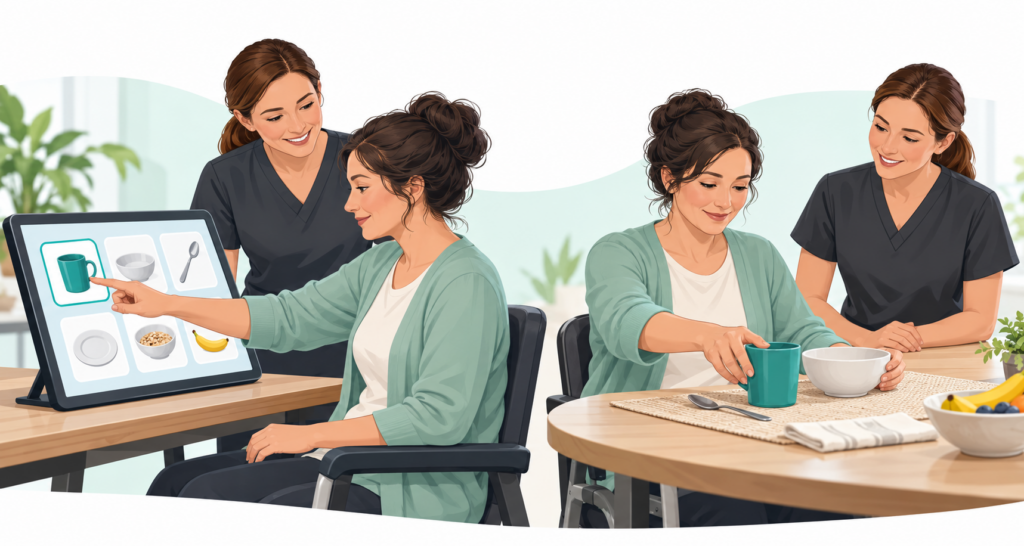
A person becomes faster at selecting objects on a screen. Another completes a virtual shopping task with fewer mistakes. These observations tell us something useful about performance in those activities. The next question is whether anything has changed outside the game: preparing breakfast, finding an item in a cupboard, organising a shopping trip or returning to a valued hobby.
Transfer means using what has been practised in a different task or setting. It should be considered when planning digital rehabilitation and checked during real activities. A realistic-looking simulation does not, by itself, demonstrate that this transfer has occurred.
Start with an activity that matters
Before choosing a game, ask what the person wants or needs to do. “Improve arm function” describes a broad rehabilitation aim. “Put the light items needed for breakfast on the table” gives the therapist and the person a shared activity to examine.
Discuss where the activity happens, which parts are difficult, what assistance is currently needed and what would count as a useful change. Independence may be one aim; comfort, reduced effort, confidence or participating with agreed support may be equally relevant.
For adults after stroke, NICE recommends goals centred on meaningful activity and participation, with therapy tailored to the person. This condition-specific guidance supports goal-led planning; it is not a universal protocol for every diagnosis. [1]
Compare the demands, not just the appearance
A digital task can look like an everyday activity while requiring different actions. Selecting a virtual cup with a controller does not reproduce grasping a cup, managing its weight or responding to a slippery surface. Likewise, remembering a short list in a quiet simulation differs from shopping in a busy store.
The therapist can compare the two situations across several dimensions: movement, attention, planning, sensory information, feedback, physical effort and environmental distractions. The practical question is: which relevant demand does this exercise actually provide, and which demands still need to be practised elsewhere?
Use a bridge between digital and everyday practice
One possible planning approach is to connect three situations: a simplified digital task, a related activity using real objects and the everyday activity in its usual context. This is an illustrative framework, not a validated treatment protocol or a fixed sequence required for everyone.
For example, someone who wants to organise breakfast items might practise identifying a small number of targets on a screen. The therapist could then observe selecting and positioning lightweight, unbreakable objects at a suitable table. A later observation could examine the relevant part of breakfast preparation in the person's own environment, where feasible and appropriate.
The digital component is useful only if its purpose is clear. It might provide structured opportunities to search, choose or reach. It cannot establish that the person can safely manage hot drinks, sharp utensils or unsupported standing.
An illustrative activity plan
| Element | Example for therapist-led planning |
|---|---|
| Functional objective | Participate in arranging selected breakfast items with an agreed level of support. |
| Intended context | An individual rehabilitation session, after assessment of movement, vision, cognition and safety needs. |
| Digital task | Identify and select the items needed for a familiar breakfast. |
| Configuration | Adjust target size and position, number of choices, distractions, input method and optional prompts, where the software allows. |
| Observable information | Selections, omissions, incorrect choices and completion time if recorded; assistance, movement strategy and comfort observed separately by the therapist. |
| Adaptation | Simplify the display, provide an alternative input or practise one step; introduce another demand only when appropriate. |
| Cautions | Check fatigue, pain, postural stability and visual comfort; pause for dizziness, nausea, distress or other concerning symptoms. |
| Documentation | Record the settings, actual assistance, tolerance and observations during a comparable real-object activity. |
This example does not describe a verified Remotion module or imply that every platform records these measures.
Check what happens without the game
Before practice, observe a relevant everyday task when possible. Repeat a comparable observation later, noting differences in equipment, instructions, assistance and fatigue. Useful questions include whether the person starts more independently, needs fewer prompts or completes the chosen activity with less effort.
A task with very similar demands provides one kind of check. A new environment or a less familiar activity asks a different question. Document these separately rather than describing all improvement as general transfer. If appropriate, a later review can examine whether a change is maintained.
Patient and caregiver accounts can add information about daily life. Record them as reported experiences, alongside direct observations, rather than treating them as identical forms of measurement.
Interpret scores within their limits
A higher game score might reflect familiarity with the rules, a different strategy, more assistance or easier settings. Faster completion can also occur with less accurate or less comfortable movement. Keep settings and support visible when comparing sessions.
For a progress note, distinguish three statements: what the software recorded, what the therapist observed and what was demonstrated during the everyday activity. If no real-world task was checked, say so. A game score is not a validated clinical measure unless the specific tool and intended interpretation have supporting validation.
What does the research allow us to say?
A 2025 Cochrane review of stroke rehabilitation reports modest benefits for some outcomes, with uncertainty varying by outcome. Evidence about participation and quality of life remains limited. These findings do not demonstrate transfer for a particular game, patient or Remotion product. [2]
The planning suggestions in this article are an editorial clinical reasoning framework. They should not be presented as a tested intervention package or as evidence of product effectiveness.
Keep the everyday goal visible
If game performance improves while the target activity does not, revisit the connection between the two. The exercise may address only one part of the difficulty; the person may also need different equipment, environmental changes, another strategy or more direct practice of the activity.
Digital rehabilitation can have a place within therapist-led care when its role is explicit. The most useful question at review is: what can the person now do in the activity that matters to them, and under what conditions?
Discuss your activity goals and clinical context with the Remotion team through the website contact page. Any proposed configuration should be assessed against the person's needs and the capabilities of the specific tools.
References
- National Institute for Health and Care Excellence. Stroke rehabilitation in adults. NG236. 2023.
- Laver KE, Lange B, George S, Deutsch JE, Saposnik G, Chapman M, Crotty M. Virtual reality for stroke rehabilitation. Cochrane Database of Systematic Reviews. 2025;6:CD008349.