

Introduction
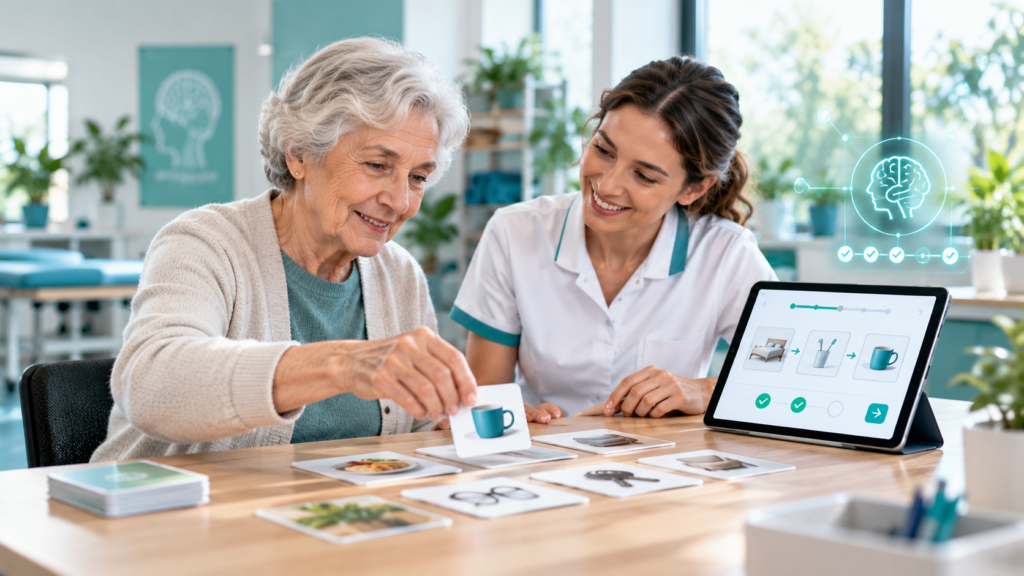
Digital cognitive tools, virtual reality (VR), interactive activities and artificial intelligence (AI) can support selected goals for people with cognitive difficulties. However, dementia care, cognitive rehabilitation after an acquired brain injury, mild cognitive impairment and dementia risk reduction are different clinical contexts. The aim is not to promise a cure or to equate game scores with recovered memory. Effective care supports autonomy, daily functioning, communication, safety, quality of life and those providing support.
Differentiate dementia, mild cognitive impairment and other cognitive disorders
Dementia is a clinical syndrome involving acquired cognitive changes that interfere with independent everyday functioning; Alzheimer’s disease is one possible cause. Mild cognitive impairment does not necessarily progress to dementia, and cognitive problems may also arise from stroke, TBI, depression, medication effects or other conditions. Assessment, treatment and prognosis differ. A digital screening score should never be used as the sole basis for diagnosis or to infer disease progression.
Cognitive rehabilitation, stimulation and training are not interchangeable
Cognitive rehabilitation works collaboratively toward personally meaningful functional goals and compensatory strategies, such as managing appointments or preparing a familiar meal. Cognitive stimulation involves engaging activities and discussion that may support general cognition and social interaction. Cognitive training uses structured practice of specific cognitive tasks, such as memory or attention exercises. These concepts overlap in practice but address different goals, evidence bases and outcome measures.
For mild-to-moderate dementia, NICE NG97 recommends group cognitive stimulation therapy, suggests considering group reminiscence and cognitive rehabilitation or occupational therapy for functional ability, and advises against offering cognitive training specifically to treat mild-to-moderate Alzheimer’s disease. This distinction is critical when evaluating computer ‘brain training’ claims.
What the 2026 WHO dementia prevention guidance actually covers
The 2026 WHO second-edition guidelines on reducing cognitive decline and dementia risk primarily concern adults without dementia, including those with normal cognition or mild cognitive impairment. They include conditional recommendations for certain cognitive activities and tailored multidomain approaches, with important limitations and differing certainty of evidence. These risk-reduction recommendations should not be misrepresented as proof that digital cognitive games treat established Alzheimer’s disease or reverse dementia.
Daily-life occupational therapy and compensatory supports
An occupational therapist may help a person develop a meaningful routine using labels, simplified layouts, accessible calendars, reminders, environmental adaptation and task sequencing. Goals can include preparing breakfast, identifying personal items, participating in hobbies or maintaining social connections. Digital tools are beneficial only if the person can actually use them, accepts them and experiences improvements in their own routines. A low-tech cue may be more suitable than an elaborate app.
Person-centred and dementia-friendly communication
Use familiar language, clear choices, predictable interactions and adequate response time. Avoid infantilizing people or assuming incapacity based solely on a diagnosis. Decision-making abilities can differ between tasks and over time; involve the person in decisions to the greatest appropriate extent and use legally valid support where needed. Visual aids, audio prompts and assistive communication can help. Respect identity, culture, preferences, distress signals and the right to decline an activity.
Serious games, reminiscence and meaningful engagement
Games and interactive activities may help create enjoyable opportunities for attention, storytelling, movement or social participation. Digital reminiscence may use personally meaningful photographs or music when the person wants to engage. The activity’s value may lie in enjoyment or connection rather than improving a cognitive test score. Avoid punitive timers, overwhelming audiovisual stimuli, unnecessary difficulty or claims that frequent play will prevent dementia. Evaluate fatigue, comfort, preferences and caregiver workload.
VR and simulated environments: potential and limitations
Non-immersive or immersive simulated scenarios may offer structured opportunities to practise selected everyday tasks or engage with familiar environments. Research remains heterogeneous by diagnosis, equipment, protocol and outcome. Simulation can cause cybersickness, anxiety, confusion, visual discomfort, balance difficulties or cognitive overload. A virtual shopping task is not evidence of independent shopping unless real-life transfer is assessed. Headsets are not mandatory and may be unsuitable for some users.
Motion tracking and cognitive performance metrics
Interactive systems may capture response time, errors, task steps, pauses, visual exploration or movement trajectories. These data can support discussion but do not automatically measure memory, executive function or disease progression. Scores can change with hearing, vision, device placement, sleep, fatigue and familiarity with the game. Standardized cognitive tests should not be converted into digital versions without checking licensing, equivalence and psychometric validation.
AI: opportunities and safeguards
AI can assist clinicians in drafting accessible instructions, creating personalized visual aids, summarizing de-identified information, or prototyping activities through low-code methods. The augmented therapist should understand model limitations, bias, fabricated outputs and data leakage risks. An AI-generated app is not necessarily a validated assessment or medical device. Automated systems should not independently diagnose Alzheimer’s disease, infer capacity, prescribe treatment or trigger high-stakes care decisions without an appropriate evidence and regulatory framework. Sensitive health information requires approved processing and human oversight.
Remotion Classic, TheraVerse and therapist-led personalization
Remotion Classic offers therapist-directed interactive rehabilitation activities across supported devices. Remotion TheraVerse provides clinician-configurable virtual rooms with interactive objects and visual, auditory and compatible vibration-based haptic cues. Clinicians might use such flexibility to create selected functional practice scenarios, but the platform’s technical features do not establish dementia-specific clinical efficacy, diagnostic validity or suitability for unsupervised use. The therapist must judge accessibility, tolerance, real-world relevance and safety.
Caregiver support without excessive burden or surveillance
Families and caregivers can support routines, environmental adaptations and communication when the person agrees and circumstances permit. They need understandable information, practical training, respite and opportunities to share concerns. NICE NG97 recommends psychoeducation and skills training for carers. Continuous location monitoring, video recording or behavioural scoring should never be the default response to cognitive impairment; consider proportionality, consent, dignity, legal authority and safer alternatives.
Hybrid care, inclusion and safety
Selected remote follow-up may support caregiver education and review of home routines, while diagnostic assessment and complex clinical issues may require direct evaluation. Check internet access, hearing, vision, dexterity, digital literacy and privacy. For people experiencing acute confusion, sudden decline or new neurological symptoms, seek timely medical assessment rather than assuming dementia progression or continuing unsupervised digital exercises.
How to measure outcomes
Agree on a small number of person-defined goals, such as following a familiar morning routine with appropriate support, participating in conversations or enjoying a valued activity. Use appropriate clinical measures, patient-reported and caregiver-reported experiences, and contextual observations. Distinguish quality of life, participation, task independence and caregiver burden from raw app scores. Avoid attributing clinically significant cognitive improvement to a programme on the basis of repeated exposure or practice effects.
Three illustrative situations
Keeping a meaningful morning routine
A person living with mild dementia and an occupational therapist choose a simple visual reminder strategy for preparing breakfast. The outcome is usefulness and autonomy in the real task, not points earned in a game.
Supporting connection with family
Selected photographs or music facilitate enjoyable reminiscence and conversation when welcomed by the person. The purpose is participation and emotional connection rather than claiming reversal of memory loss.
Hybrid support for a caregiver
A clinician provides education and follow-up concerning communication and environmental cues, while reassessing the person’s needs face to face when necessary. Caregiver burden and the person’s preferences guide adjustments.
Illustrative examples, not personalized medical prescriptions.
Regulatory reminder: Europe, United States and Middle East
European Union
The GDPR governs personal and health-data processing, with particular attention to sensitive information and lawful access. Software with a medical intended purpose may fall under MDR 2017/745. The EU AI Act may add requirements according to intended AI use and risk; verify the current regulatory timetable and applicable amendments.
United States
The FDA assesses medical-purpose software functions and relevant exclusions. HIPAA applies to covered entities and business associates in specified situations, not all consumer services. FTC requirements and state rules may also apply.
Middle East
There is no uniform regional framework. In Saudi Arabia, assess SFDA digital-health rules and personal-data protection requirements. In the UAE, review relevant medical-product and health-data rules including Federal Law No. 2 of 2019. In Qatar, consider Personal Data Privacy Protection Law No. 13 of 2016 and health-sector requirements. Cross-border transfers, hosting, professional practice and consent or decision-making authority need country-specific review.
A leisure game, a care reminder app, a cognitive screening device and AI proposing diagnoses can have different obligations. This overview is educational and not legal advice.
Frequently asked questions
Can digital games cure dementia?
No. Claims of curing or reversing dementia through games are not supported.
Is cognitive training recommended for established Alzheimer’s disease?
NICE NG97 advises against offering cognitive training specifically to treat mild-to-moderate Alzheimer’s disease, while recommending cognitive stimulation therapy and considering functional cognitive rehabilitation or occupational therapy in relevant circumstances.
Does WHO 2026 recommend digital games to treat dementia?
No. Its risk-reduction guidance concerns people without dementia, including normal cognition or mild cognitive impairment, and should not be confused with treatment guidance.
Can AI diagnose dementia from a game score?
Not safely without specific clinical evidence, validation, professional oversight and regulatory assessment.
What should families measure?
Agree on practical outcomes such as independence, comfort, communication, participation and caregiver workload rather than tracking everything continuously.
Conclusion and references
Digital cognitive rehabilitation and dementia care should be grounded in dignity, daily function, informed choice and meaningful relationships. Differentiate the evidence for cognitive stimulation, functional rehabilitation, cognitive training and dementia prevention. Interactive tools and AI can help therapists personalize accessible support, but should not replace validated assessment, multidisciplinary care or the voices of people living with cognitive difficulties.
Related articles: TBI and Digital Rehabilitation; Measuring Outcomes in Hybrid Rehabilitation; Family-Centered Rehabilitation.